
Are Builder Reviews Reliable?
Written by James Walker · Last reviewed 15 August 2026
James Walker has 2 degrees in construction (BSc (Hons) Building Surveying · MSc Environmental Design of Buildings) and an extensive background in issue resolution, resolving over £4 billion of consumer issues.
The short answer
- Reviews are one signal among several, and among the weaker ones.
- The pattern matters more than the average, read the middling ones first.
- A handful of very recent five-star reviews after a long gap is worth noticing.
- How a business responds to criticism tells you more than the praise does.
- Speaking to a real previous customer beats any number of reviews.
On this page
What reviews are good for
They are genuinely useful for spotting patterns. If several unconnected people describe the same problem, poor communication, jobs left unfinished, prices creeping up, that is real information.
They also show how a business behaves under criticism, which is the closest thing you get to seeing how they would treat you if something went wrong.
What they are weak at
Reviews are written by people at the emotional peaks of a job, immediately after completion. They capture the finish and the manner, and almost never the things that matter later, whether the work lasted, whether certification was provided, whether the snagging ever got done.
They are also easy to influence. Trades can ask happy customers to review and quietly not ask unhappy ones, without anything dishonest occurring.
How to read them properly
Read the three-star reviews first. They are the most honest, usually written by someone with no agenda who is describing a mixed experience accurately.
Look at timing. A long gap followed by a cluster of glowing reviews is worth a second look.
Look at specificity. Real reviews mention particular things: the job, the timescale, a specific person. Vague praise carries little weight.
Look at the responses. A defensive or aggressive reply to a fair criticism tells you exactly how a dispute with you would go.
What to do instead
Ask for two recent customers with jobs like yours, and speak to them.
Ask what went wrong rather than whether they were happy. Every job has something. What you are testing is not whether problems occurred but how the builder handled them.
Then ask the question that actually matters: would you use them again for something bigger? It is harder to answer politely than "were you happy", and the hesitation is informative.
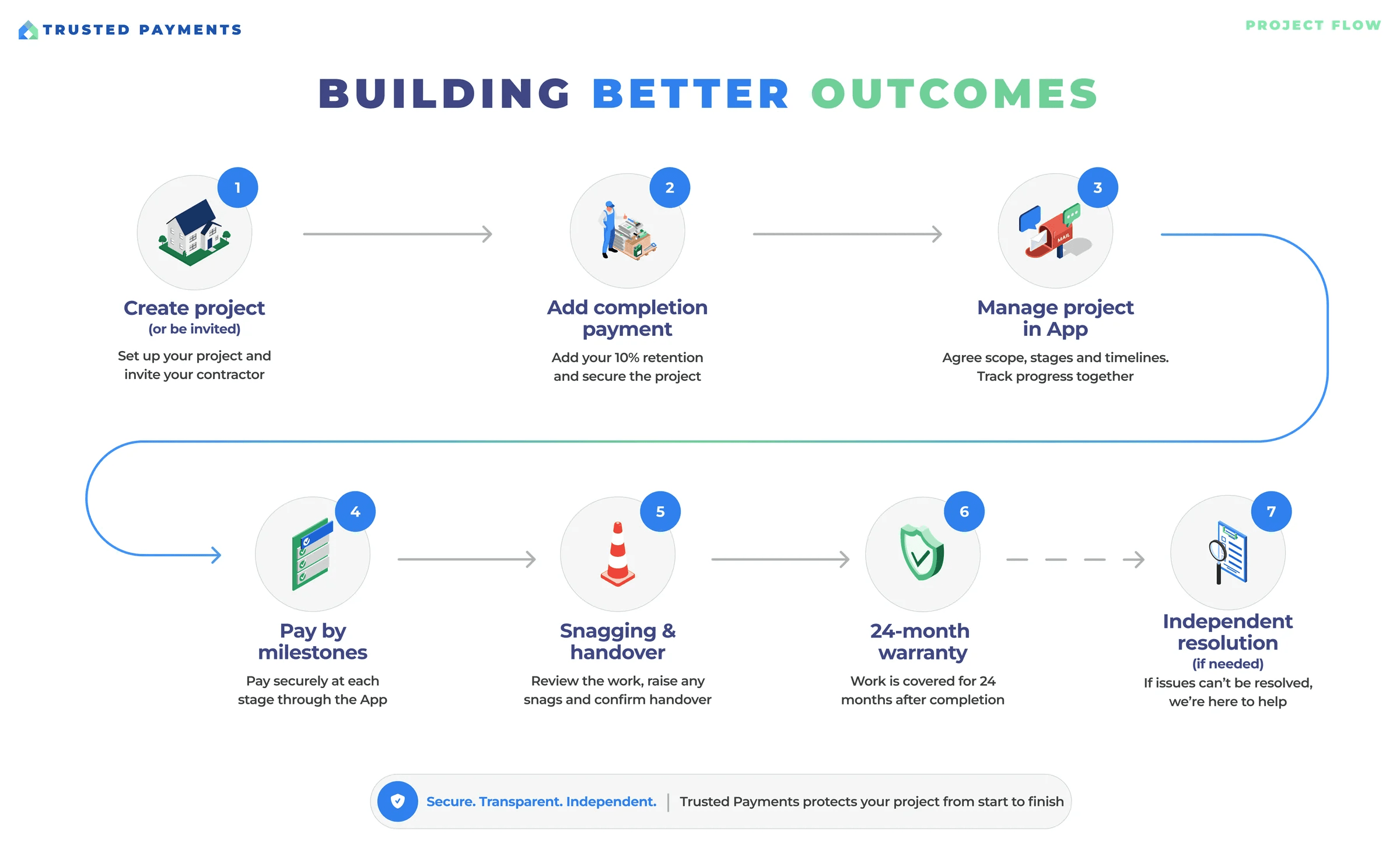
How it works
Help your project succeed with Trusted Payments
Related guides
Common questions
- Should I ignore reviews entirely?
- No. Use them to spot patterns, not to make the decision.
- What about a builder with no reviews?
- Common among trades working on referral. Judge on references and registrations.
- Are review sites with verification better?
- Somewhat, since they limit fabricated reviews. They do not fix selective asking.
- One terrible review among many good ones?
- Read it and the response. Sometimes it is a difficult customer; sometimes it is the only honest one.