
How Many Quotes Should You Get?
Written by James Walker · Last reviewed 15 August 2026
James Walker has 2 degrees in construction (BSc (Hons) Building Surveying · MSc Environmental Design of Buildings) and an extensive background in issue resolution, resolving over £4 billion of consumer issues.
The short answer
- Three is the usual advice and it holds up, provided all three are quoting for the same scope.
- Quotes are only comparable if you gave every builder the same written brief.
- The lowest quote is often the one that has left something out.
- Compare exclusions and payment terms, not just the headline figure.
- A quote is a fixed price. An estimate is not, and the difference matters.
On this page
Why three
Fewer than three and you have no sense of the range. Many more and the process stalls, good builders lose interest in bidding against a crowd, and you end up choosing between people you have kept waiting.
Three gives you a middle. It is the outliers that are informative: the quote well above the others usually includes something, and the one well below usually excludes something.
Make them comparable first
This is where most people go wrong. If you describe the job differently to each builder, you get three quotes for three different jobs and the comparison is meaningless.
Write the brief once. Include what you want done, what you are supplying yourself, the standard of finish, any materials already chosen, access constraints, and when you want it done. Send the same document to all three.
Ask each to itemise, and to state explicitly what is excluded.
Quote or estimate?
A quote is a fixed price for defined work. A builder who quotes and then charges more needs a reason tied to a change in scope.
An estimate is a considered guess. It can move.
Both are legitimate, some work genuinely cannot be priced until it is opened up. What matters is knowing which you have. If the document does not say, ask, and get the answer in writing.
What to compare besides price
- Exclusions. The most useful section, and the one most often missing.
- Payment terms. A lower price with half up front may be a worse deal than a higher one paid in stages.
- Timescale, and whether they can commit to it.
- What happens to waste.
- Whether making good is included, plastering, decorating, tidying the edges.
- Materials specification. "Tiles" and a named tile are different quotes.
The lowest quote
Sometimes it is genuinely a better price, lower overheads, or the builder wants the job.
More often, it is missing something. Before accepting, go back with the specific question: what have you excluded that the others may have included? A straightforward builder will tell you.
Be particularly careful when the lowest quote also comes with the largest deposit request. That combination is unusual for a healthy business.
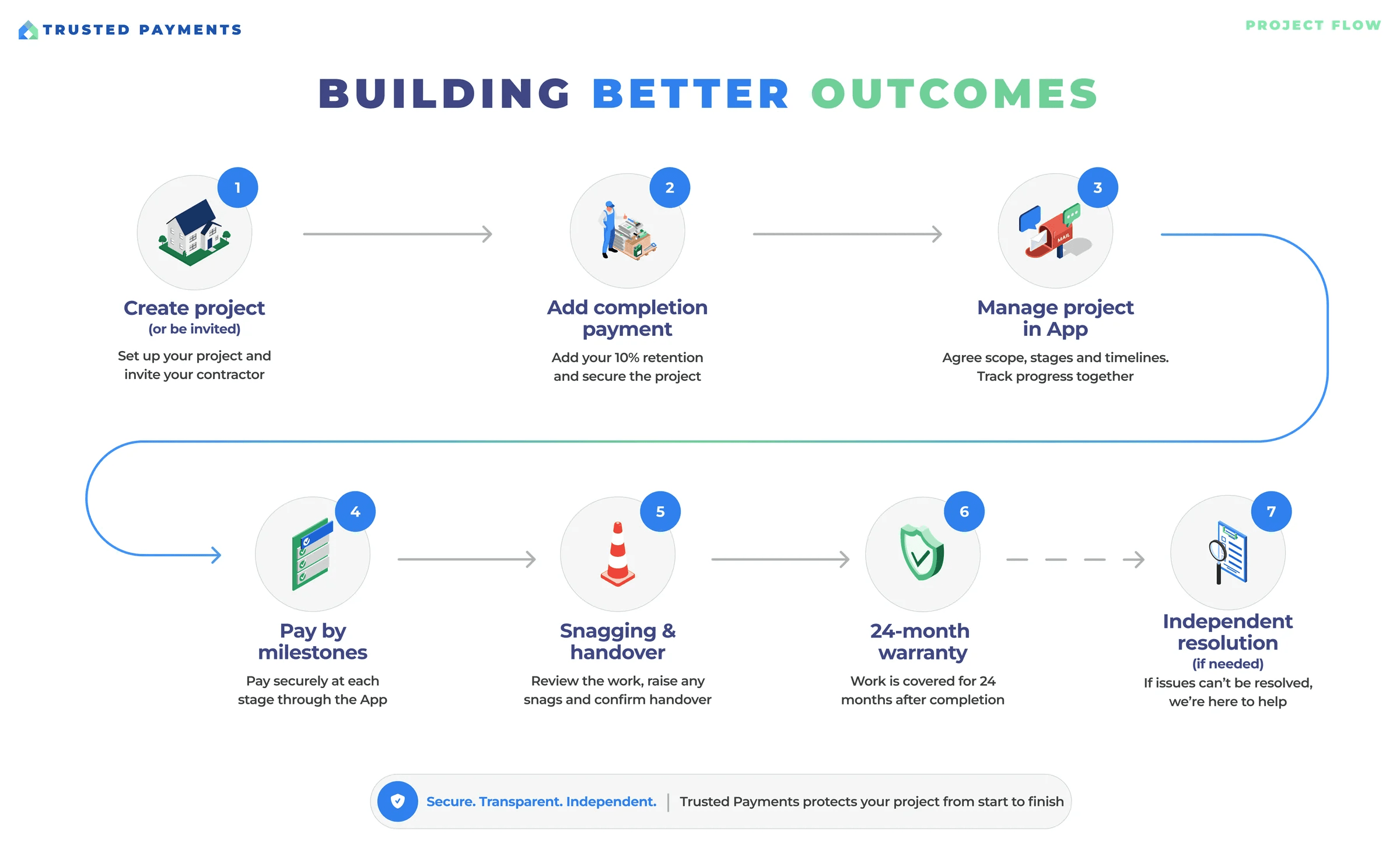
How it works
Help your project succeed with Trusted Payments
Related guides
Common questions
- Should I tell builders what others quoted?
- Generally no. It invites matching rather than accurate pricing.
- Is it rude to get three quotes?
- No. It is normal and expected.
- What if two are close and one is far higher?
- Ask the higher one what they have included. Sometimes it is the only complete quote.
- Can I negotiate?
- On scope, usually. On price alone, you are often just moving something into the exclusions.