
The Work Is Defective. What Are My Rights?
Written by James Walker · Last reviewed 15 August 2026
James Walker has 2 degrees in construction (BSc (Hons) Building Surveying · MSc Environmental Design of Buildings) and an extensive background in issue resolution, resolving over £4 billion of consumer issues.
The short answer
- Work must be carried out with reasonable care and skill. That is a legal requirement, not a courtesy.
- Materials supplied as part of the job must be of satisfactory quality and fit for purpose.
- Your first remedy is usually repeat performance, the builder puts it right at their own cost.
- If they cannot or will not, within a reasonable time and without significant inconvenience to you, you may be entitled to a price reduction.
- Give them the chance to fix it in writing first. Going straight to someone else can weaken your position.
On this page
What the law actually requires
Under the Consumer Rights Act 2015, a trader providing a service to a consumer must perform it with reasonable care and skill. Where materials are supplied as part of that service, they must be of satisfactory quality, fit for purpose, and as described.
"Reasonable care and skill" means the standard a competent person in that trade would achieve. It is not perfection, and it is not your personal preference. Tiles laid to a poor standard fail the test. Tiles laid well in a colour you have gone off do not.
Anything the builder told you that you relied on when deciding to hire them can also be binding, including statements about how long it would take or what it would cost.
Repeat performance, the first remedy
In most cases the builder gets the opportunity to put it right, at their own cost and without significant inconvenience to you.
This matters practically: give them that chance, in writing, before hiring anyone else. People who bring in a second trade immediately, then try to recover the cost, often find their position is weaker than it would have been.
Write down what is wrong, be specific, and give a reasonable deadline.
Price reduction
If repeat performance is impossible, or the builder does not do it within a reasonable time, or doing so would cause you significant inconvenience, a price reduction may be appropriate. How much depends on how far the work falls short.
This is where holding back a final payment matters. If you still hold the retention, a price reduction is a conversation. If everything has been paid, it becomes a recovery exercise.
Proving the work is defective
Disagreements about quality usually come down to evidence.
Photograph the defects clearly, with something for scale where it helps. Keep the original specification and quote, since "defective" often means "not what was agreed" rather than "badly done".
On anything substantial, an independent report from a surveyor or a specialist carries far more weight than your own description. It costs money, and on a large job it is usually worth it.
If the builder disagrees
Two competent people can genuinely disagree about whether work meets standard. That is exactly what independent dispute resolution exists for, someone with the relevant expertise looks at the evidence and reaches a decision, without either party needing to go to court.
Check whether your builder belongs to a scheme with an ombudsman route. It is faster, cheaper, and considerably less stressful than litigation.
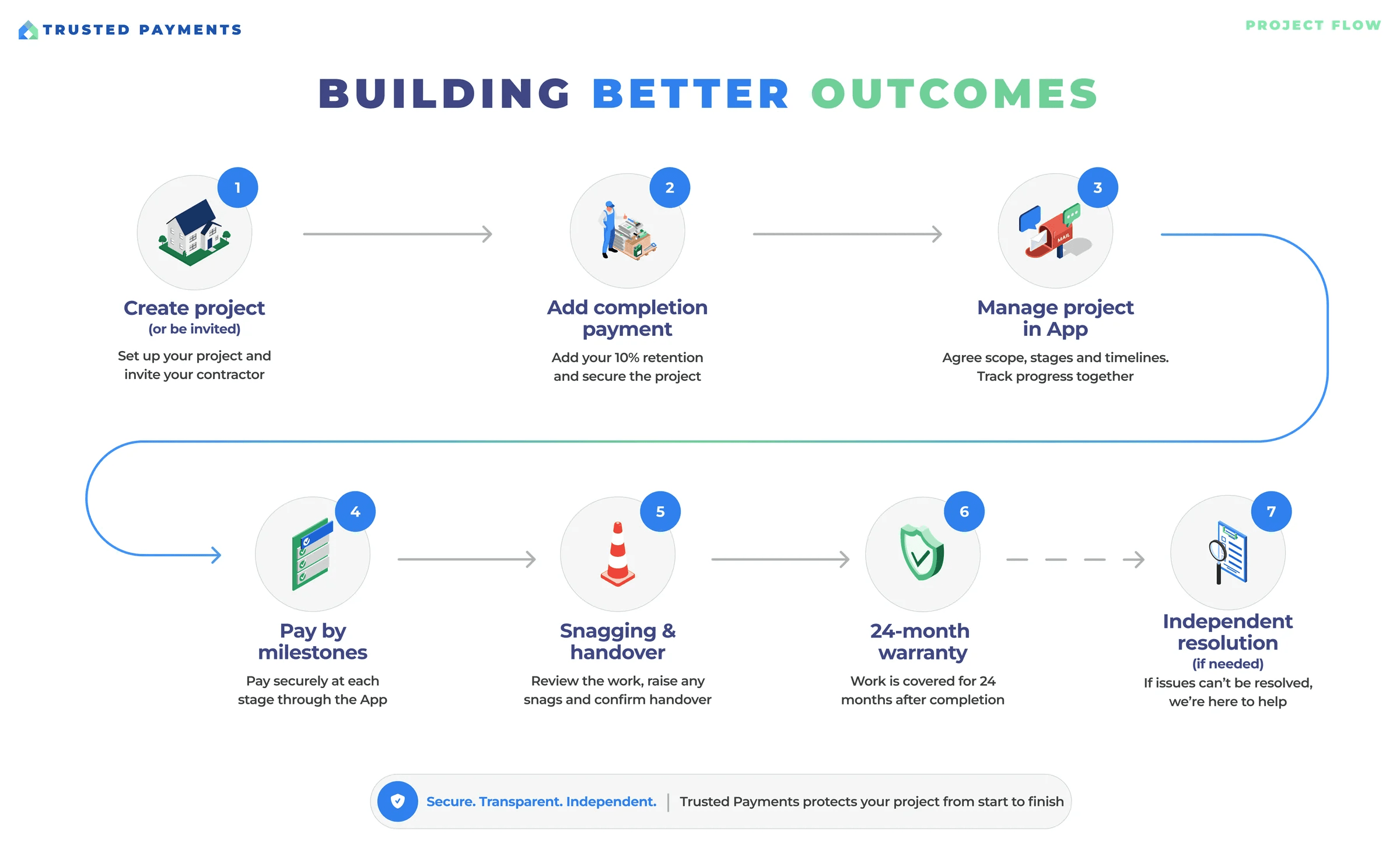
How it works
Help your project succeed with Trusted Payments
Related guides
Common questions
- Can I withhold payment for defective work?
- You can withhold what is genuinely in dispute. Withholding everything over one defect may put you in breach.
- What if I only noticed months later?
- You may still have rights. Time limits vary, so take advice rather than assuming it is too late.
- Does a guarantee change things?
- A guarantee sits alongside your legal rights; it does not replace them.
- What if the builder used the wrong materials?
- Materials must be as described. Substitution without agreement is a breach.