
How to Complain About a Builder
Written by James Walker · Last reviewed 15 August 2026
James Walker has 2 degrees in construction (BSc (Hons) Building Surveying · MSc Environmental Design of Buildings) and an extensive background in issue resolution, resolving over £4 billion of consumer issues.
The short answer
- Start with the builder, in writing. Most routes later will ask whether you did.
- Be specific about what is wrong and what you want done. Vague complaints get vague responses.
- Give a reasonable deadline and keep every reply.
- Escalate to their accreditation scheme or ombudsman before considering court.
- Keep the tone factual throughout, it is more effective, and it reads better if a third party ever sees it.
On this page
Step 1, Complain to the builder, in writing
Even if you have already discussed it. A written complaint creates the record every later route depends on.
Include what was agreed, what has happened, what specifically is wrong, what you want done, and by when. Attach photographs. Keep it factual and unemotional, not for the builder's benefit, but because an ombudsman or judge may read it.
Step 2, Give them a real opportunity to put it right
This is not a formality. In most cases the builder is entitled to the chance to fix the problem, and skipping this step can weaken your position later.
A reasonable deadline depends on the work. A few weeks for minor items; longer for anything substantial.
Step 3, Escalate to their scheme or ombudsman
If the builder belongs to an accreditation scheme, this is the point to use it. Schemes vary in what they can require, but membership itself often produces a response where direct contact has not.
An ombudsman looks at the evidence from both sides and reaches a decision. It is faster than court, usually free or low cost to the consumer, and does not require a solicitor.
Step 4, Trading Standards
Report through the national consumer service. They generally will not resolve your individual dispute, but reports build the record against traders who do this repeatedly, and that has real value even when it does not help you directly.
Step 5, Legal action
The last resort. For smaller sums the small claims route is designed to be used without a solicitor. For larger or more complex claims, take advice first.
Before starting, be realistic about two things: the time it takes, and the difference between winning and being paid.
What makes a complaint effective
- Specific rather than general, "the tiling in the main bathroom is uneven across the north wall", not "the tiling is bad"
- Evidenced with photographs and the original specification
- Clear about the outcome you want
- Deadlined, and then followed through
- Consistent, the same account each time
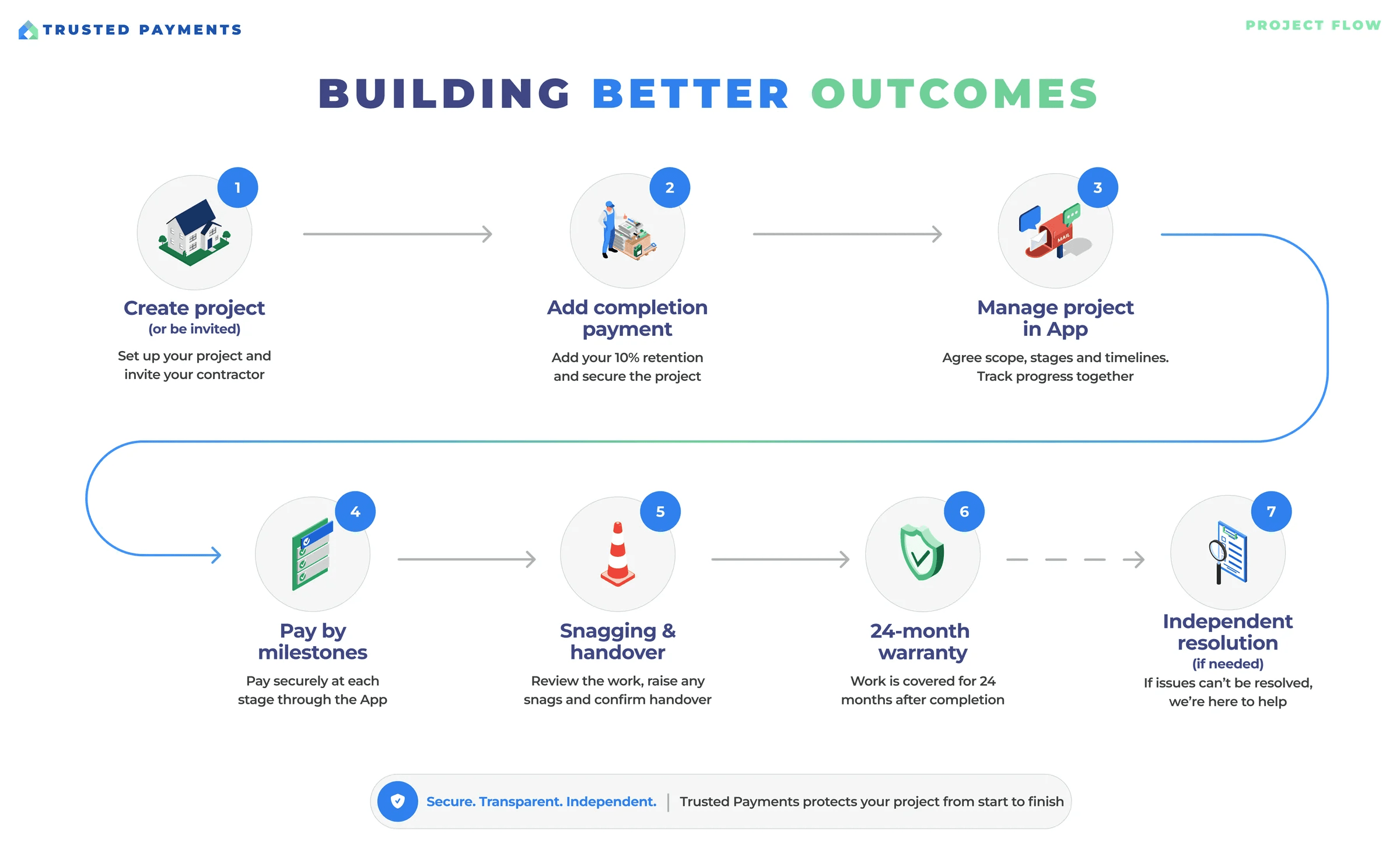
How it works
Help your project succeed with Trusted Payments
Related guides
Common questions
- Should I leave a review?
- Fine, but keep it factual, and be aware it may harden the builder's position while you are still trying to resolve things.
- Can I complain if I paid cash?
- Yes, though proving what you paid is harder.
- What if the builder is not in any scheme?
- Your route is direct contact, then Trading Standards, then court.
- How long do I have?
- It varies. Do not assume it is too late, take advice.