
What Electrical Work Needs Certifying?
Written by James Walker · Last reviewed 15 August 2026
James Walker has 2 degrees in construction (BSc (Hons) Building Surveying · MSc Environmental Design of Buildings) and an extensive background in issue resolution, resolving over £4 billion of consumer issues.
The short answer
- Notifiable: new circuits, consumer unit replacement, and any fixed work in a bathroom, shower room, sauna or swimming pool.
- Not notifiable: like-for-like replacements, and adding a socket or switch to an existing circuit outside those locations.
- Non-notifiable work still has to comply with BS 7671. It just does not have to be reported.
- A registered electrician can self-certify. Otherwise you notify building control before work starts.
- Get the certificate. Missing certification surfaces at sale.
On this page
Applies to England and Wales. Scotland and Northern Ireland differ.
What is notifiable
- Any new circuit from the consumer unit, an EV charger, a kitchen appliance circuit, an outbuilding, a solar installation
- Replacing the consumer unit. Always notifiable.
- Any fixed electrical work in a special location, bathrooms, shower rooms, saunas, swimming pools. This includes minor additions and alterations there, which surprises people.
- New circuits outdoors, garden lighting, sheds, EV charge points
What is not notifiable
- Replacing a socket, switch or light fitting like for like
- Adding a socket or a lighting point to an existing circuit, outside a special location
- Repairs
None of this is a free pass on standards. All electrical work in a dwelling must comply with BS 7671, the Wiring Regulations. The distinction is only about whether it must be reported.
The two routes
Registered electrician self-certifies. Schemes include NICEIC, NAPIT and ELECSA. They notify on your behalf and issue the certificate. Verify registration on the scheme's own register.
Building control notification. Where the electrician is not registered, or where you do the work yourself, you must notify building control before starting, and pay for inspection. It is slower and more expensive.
DIY is not exempt. A homeowner carrying out notifiable work must notify.
The certificate
For notifiable work you should receive certification confirming compliance. For smaller work, a minor works certificate.
Ask for it before the final payment, not after. That is the only leverage point that reliably produces it, and it is the document conveyancing asks for.
If it was never certified
Options are an EICR from a registered electrician assessing the installation's condition, retrospective regularisation through building control, or indemnity insurance. None is as cheap as doing it at the time.
How it works
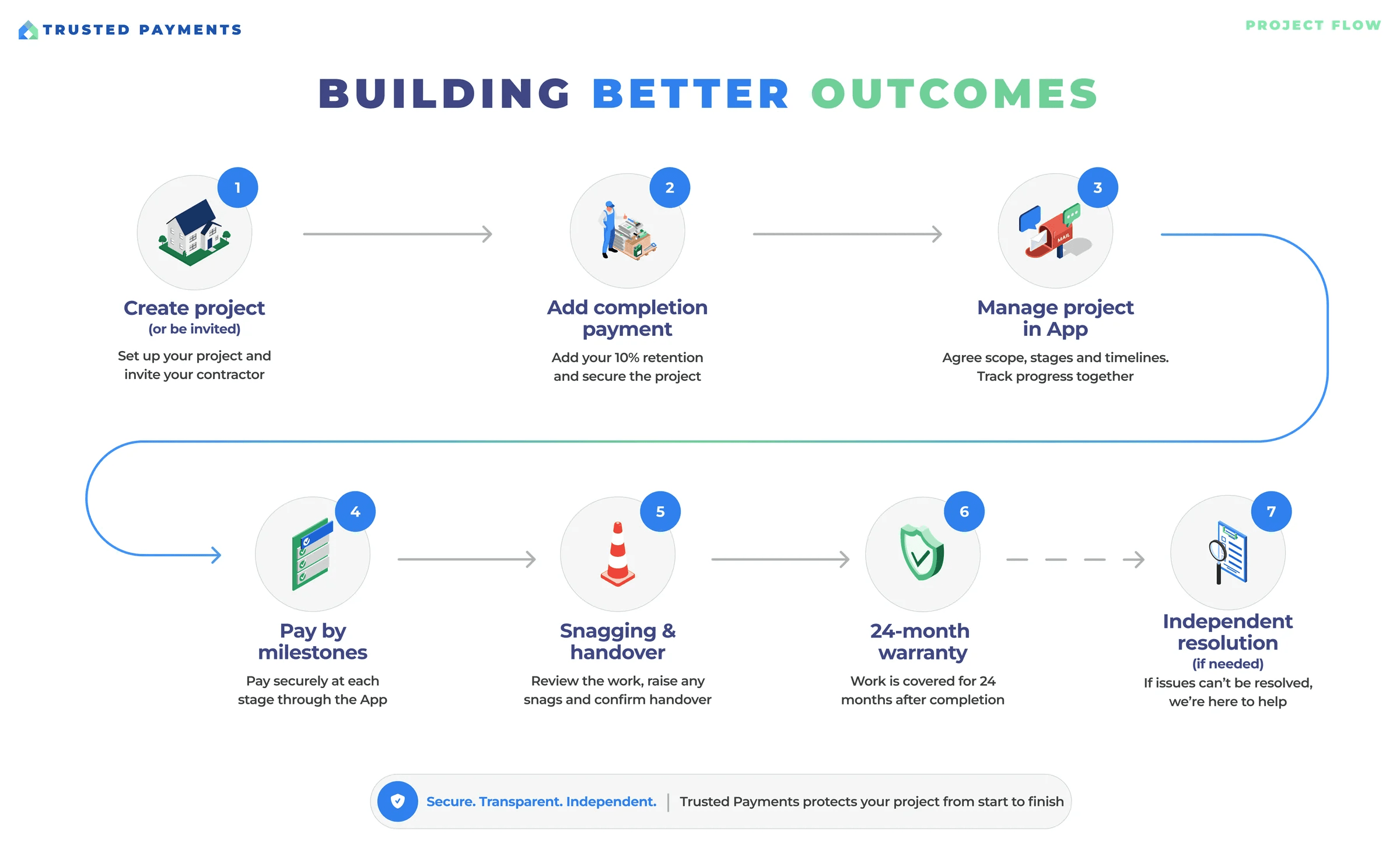
Help your project succeed with Trusted Payments
Related guides
Common questions
- Can I do my own electrical work?
- Non-notifiable work, yes. Notifiable work must be notified.
- What if my electrician is not registered?
- They can still do the work, but building control must be notified first.
- What is an EICR?
- A condition report on an existing installation, not a certificate for new work.
- Do the rules apply in Scotland?
- No. Scotland uses building warrants and has no notifiable/non-notifiable split.