
How to Hire an Electrician
Written by James Walker · Last reviewed 15 August 2026
James Walker has 2 degrees in construction (BSc (Hons) Building Surveying · MSc Environmental Design of Buildings) and an extensive background in issue resolution, resolving over £4 billion of consumer issues.
The short answer
- Certain electrical work is notifiable under the Building Regulations. The paperwork is not optional.
- Use a registered electrician who can self-certify, or budget for building control involvement.
- Get the certificate. Missing certification causes real problems when you sell.
- You cannot judge electrical work by looking at it, so registration matters more than in most trades.
- An EICR is the way to find out the condition of what you already have.
On this page
What makes hiring an electrician different
Electrical work is one of the few domestic trades where the law specifies who may do what and what must be recorded, and where the consequences of getting it wrong are safety rather than aesthetics.
It is also unverifiable by eye. A consumer unit can look immaculate and be wired badly. A socket can work perfectly and be connected in a way that is dangerous under fault conditions. You have no way of assessing this, which is why the registration and the certificate carry the weight that your own judgement cannot.
Registration and what is notifiable
In England and Wales, certain domestic electrical work is notifiable under Part P of the Building Regulations. Electricians registered with a competent person scheme, NICEIC, NAPIT, ELECSA and others, can self-certify. Otherwise the work must be notified to building control before it starts, which costs money and takes time.
Notifiable: any new circuit, replacing the consumer unit, and any fixed electrical work in a special location, bathrooms, shower rooms, saunas and swimming pools, including minor additions and alterations there.
Not notifiable: like-for-like replacements, and adding a socket or switch to an existing circuit outside those special locations. It still has to comply with BS 7671; it just does not have to be notified.
England and Wales publish separate guidance and the rules are not identical, so check for the nation where the work is done. Scotland and Northern Ireland have entirely different frameworks.
Verify registration on the scheme's own register using the company name. Confirm the registration covers domestic installation work.
The certificate is part of what you are buying
This is the point most homeowners miss.
For notifiable work you should receive certification confirming the installation complies. Keep it. It is requested during conveyancing, and its absence can hold up a sale or require retrospective inspection at your cost.
For smaller work you should still receive a minor works certificate. Ask for it before final payment, not afterwards, that is the only leverage point that reliably produces it.
What a good electrical quote looks like
- Exactly what is being installed, moved or replaced
- Whether the work is notifiable, and who is certifying it
- Whether any building control fee is included
- Whether making good, chasing, plastering, decorating, is included, and to what standard
- Consumer unit work: whether an upgrade is needed and why
- Testing and certification, explicitly listed
The making-good point causes recurring disputes. Chasing cables into walls creates damage that has to be repaired, and many electricians quote for the electrical work only. Establish who is filling, plastering and decorating.
Deposits and payment stages
Materials are a smaller proportion here than in most trades, roughly a fifth to a quarter of the job, so large deposits are not justified. Around 10% is reasonable, and on smaller work none at all.
On a rewire, sensible stages are: first fix complete, plastering, second fix, then testing and certification. Hold the final 10% until the certificate is in your hands, not until the sockets work.
That single sentence is the most useful thing on this page. Certification is the part most often delayed indefinitely, and the final payment is what prevents that.
What usually goes wrong
- Certificates never issued, discovered years later during a sale
- Notifiable work carried out unregistered and unnotified
- Making good excluded, leaving chased walls to be dealt with
- Consumer unit upgrades sold unnecessarily
- Additional work "found" mid-job in a way the homeowner cannot assess
Questions to ask an electrician
- What is your scheme registration number, and does it cover domestic work?
- Is this work notifiable, and who is certifying it?
- What certificate will I receive, and when?
- Is making good included, and to what standard?
- Does the consumer unit need work, and can you show me why?
- Will you test the existing installation as part of this?
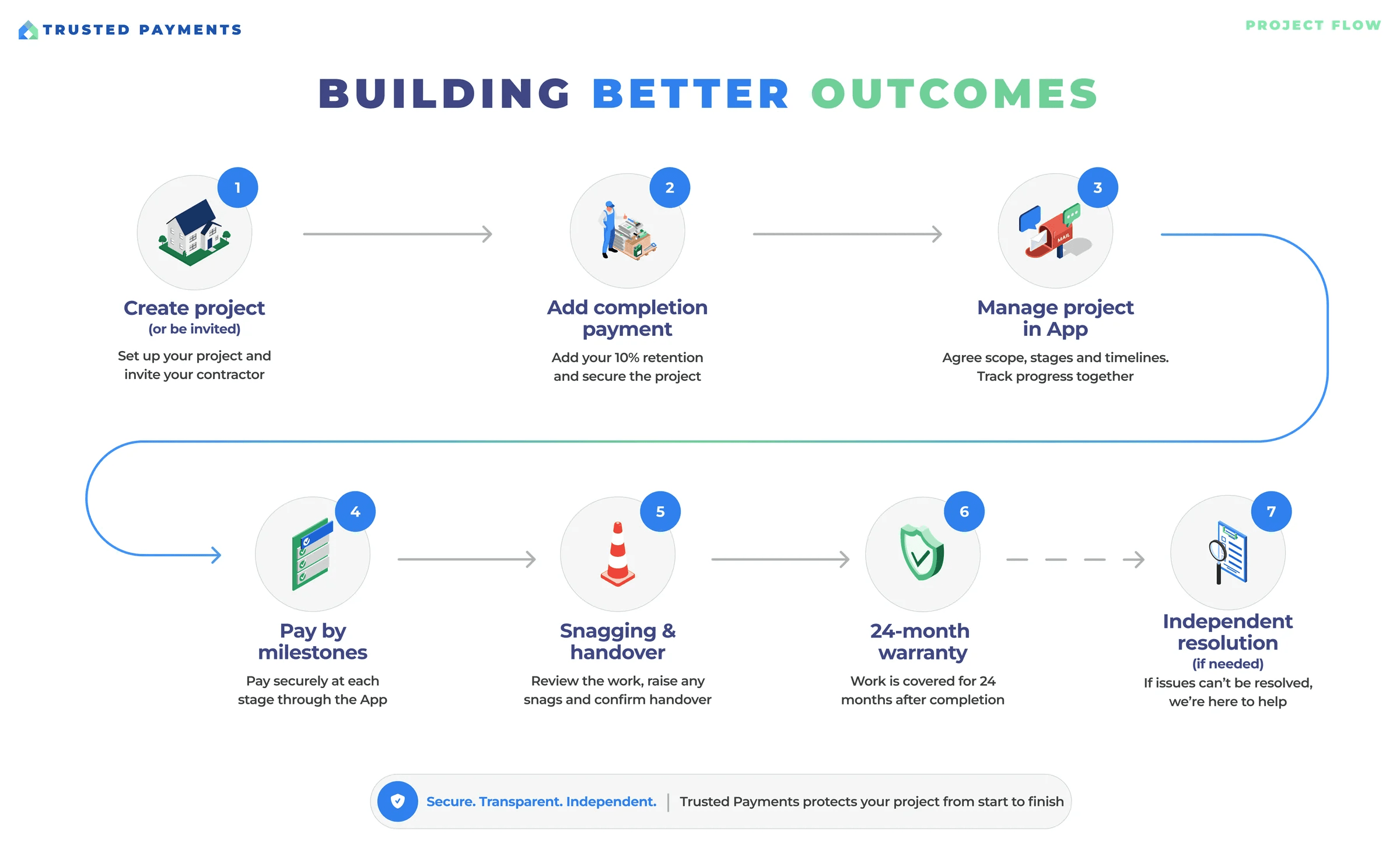
How it works
Help your project succeed with Trusted Payments
Related guides
Common questions
- What is an EICR?
- An inspection report on the condition of an existing installation. Worth having on an older property or before major work.
- Do I need a full rewire?
- Not always. Age alone is not the test, condition is. An EICR answers it.
- Can I do electrical work myself?
- Some minor work, but notifiable work requires registration or building control notification. Uncertified work causes problems at sale.
- How long does a rewire take?
- Usually one to two weeks for a typical house, plus making good.