
What Building Work Needs Building Control Approval?
Written by James Walker · Last reviewed 15 August 2026
James Walker has 2 degrees in construction (BSc (Hons) Building Surveying · MSc Environmental Design of Buildings) and an extensive background in issue resolution, resolving over £4 billion of consumer issues.
The short answer
- Extensions, loft conversions, structural alterations and new drainage all need approval.
- Some work can be self-certified by registered installers instead, windows, most electrical work, boilers, roofing.
- Either route should produce a certificate. That document is what a buyer's solicitor asks for.
- The duty sits with you as owner, even where the builder makes the application.
- Approval is separate from planning permission.
On this page
Applies to England and Wales.
Work that needs approval
- Extensions and conservatories above a certain size
- Loft and garage conversions
- Removing or altering load-bearing walls, and inserting beams
- New or altered drainage
- Replacing a roof covering over a significant area
- Installing or replacing heating appliances
- Replacement windows and external doors
- Certain electrical work
- Underpinning
- Anything affecting fire safety or means of escape
The self-certification route
For much of the above, a registered installer can certify their own work rather than involving building control:
| Work | Scheme |
|---|---|
| Replacement windows and doors | FENSA or CERTASS |
| Notifiable electrical work | NICEIC, NAPIT, ELECSA |
| Gas appliances and boilers | Gas Safe |
| Re-roofing | CompetentRoofer |
This is cheaper and faster than a building control application, and it produces a certificate you keep. It only works if the installer is genuinely registered, check the scheme's own register, not a logo on a van.
The building control route
Where self-certification is not available, you apply to building control, either the local authority or an approved inspector.
Inspections happen at defined stages: foundations before pouring, damp course, drainage before covering, structure, insulation, completion. Missing an inspection can mean opening up completed work, which is expensive and avoidable.
At the end you should receive a completion certificate.
What you should end up holding
For every piece of notifiable work: a certificate. Building control completion certificate, FENSA or CERTASS certificate, electrical installation certificate, Benchmark and Gas Safe records, MCS certificate for renewables.
Keep them together with the property documents. Every one of them will be asked for at sale.
The practical point: hold your final payment until the certificates exist. On several kinds of work the paperwork is a substantial part of what you paid for, and it is the part most often left undone once the trade has moved on.
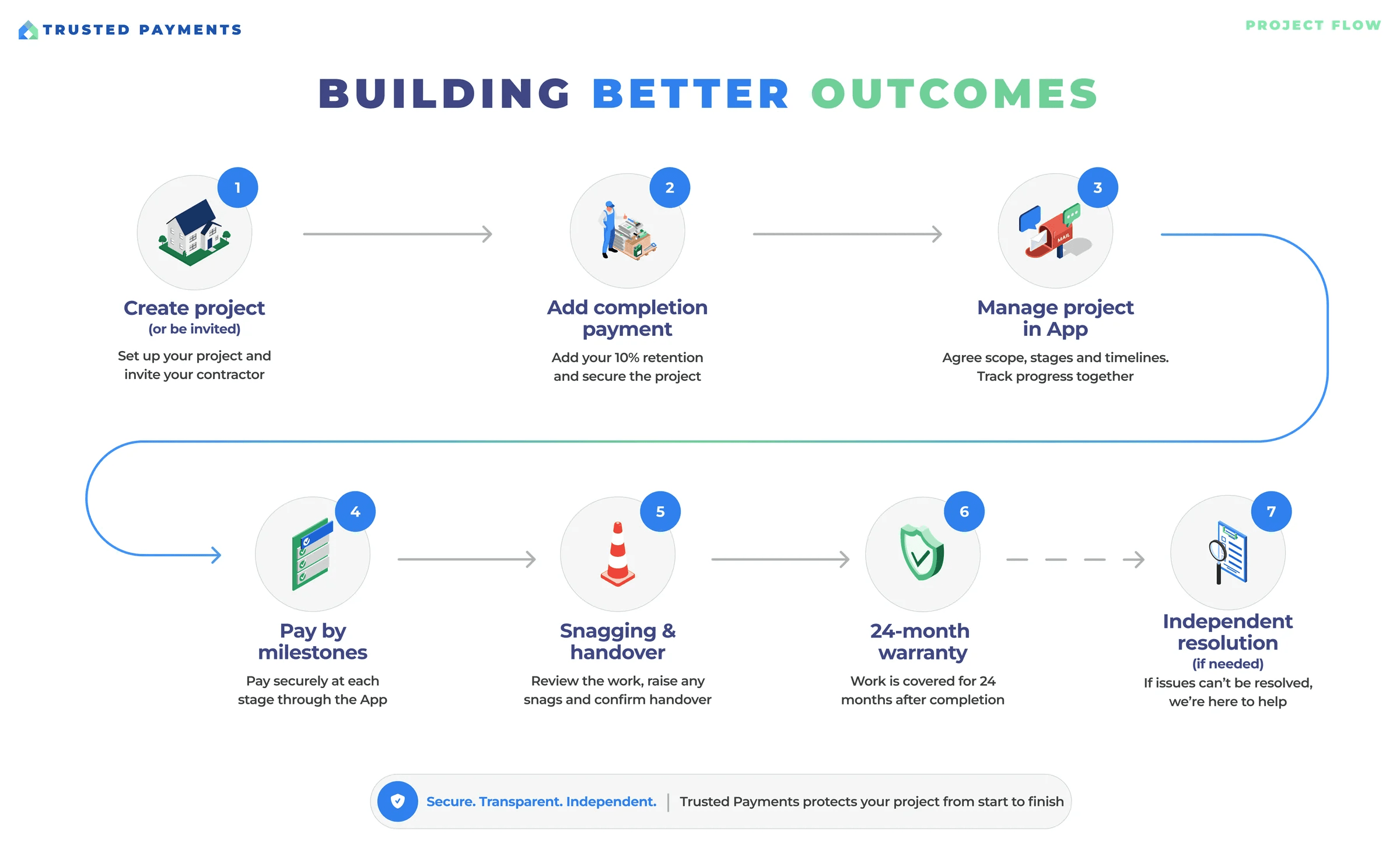
How it works
Help your project succeed with Trusted Payments
Related guides
Common questions
- Who applies?
- Usually the builder, but confirm it and confirm the fees are included.
- What does it cost?
- Varies by authority and project size. Ask for it to be itemised.
- Can I get approval afterwards?
- Sometimes, through regularisation. It costs more.
- Is an approved inspector as good as the council?
- Both are valid routes.