
What Happens If Work Was Done Without Permission?
Written by James Walker · Last reviewed 15 August 2026
James Walker has 2 degrees in construction (BSc (Hons) Building Surveying · MSc Environmental Design of Buildings) and an extensive background in issue resolution, resolving over £4 billion of consumer issues.
The short answer
- Most people discover this at sale, when the buyer's solicitor asks.
- There are three routes: regularisation, retrospective application, or indemnity insurance.
- Indemnity insurance covers the risk of enforcement. It does not make the work compliant or safe.
- Missing Building Regulations certification is a safety question as well as a paperwork one.
- Listed buildings are different, unauthorised work there is a criminal offence.
On this page
Applies to England and Wales.
How it surfaces
Almost always at conveyancing. The buyer's solicitor asks for planning permission and Building Regulations certificates for anything that has been altered, and the seller cannot produce them.
Sometimes it is discovered earlier: a surveyor's report, a remortgage, an insurance claim, or another trade noticing that a previous installation was never certified.
The three routes
Retrospective planning application. Where planning permission was needed and not obtained. The council considers it as if it were new. It may be refused, and enforcement can follow.
Regularisation. For Building Regulations. You apply to building control to assess work already done. They may require opening up parts of it to inspect, which is the expensive bit. If it complies, a regularisation certificate is issued.
Indemnity insurance. A policy covering the cost if the council takes enforcement action. It is quick and comparatively cheap, and it is what most sales use.
What indemnity insurance does not do
Worth being blunt about, because it is widely misunderstood.
An indemnity policy covers the financial risk of enforcement. It does not make the work compliant, does not confirm it is safe, and does not fix anything.
If a loft conversion has no fire escape route, or a rewire was never tested, indemnity insurance addresses none of that. It addresses the council's paperwork, not the risk to the people living there.
Policies are also usually invalidated if you contact the council about the work, which is why sellers are advised not to, and why a buyer who wants the work assessed properly has to choose between the two.
Time limits
Enforcement is subject to time limits that vary by breach type and have changed in recent years. Do not assume old work is automatically immune, and do not assume it is not. Take advice on your specific circumstances rather than relying on a general figure. [VERIFY current enforcement periods before publishing]
Building Regulations non-compliance is a separate matter from planning enforcement, and the safety issue does not expire at all.
If you are buying
Establish what is missing and why. Ask whether the work is likely to be compliant, not just whether it is insurable.
For structural work, a loft conversion, or a rewire, consider paying for an independent assessment. An indemnity policy tells you nothing about whether the thing is safe.
If you are the one who had the work done
If a trade told you they would handle certification and did not, that is a failure to deliver part of what you paid for. Where the work is recent and the trade still exists, pursue it, the certificate is their obligation.
This is also the argument for holding a final payment until the paperwork exists. Once it is settled, obtaining a certificate depends entirely on goodwill.
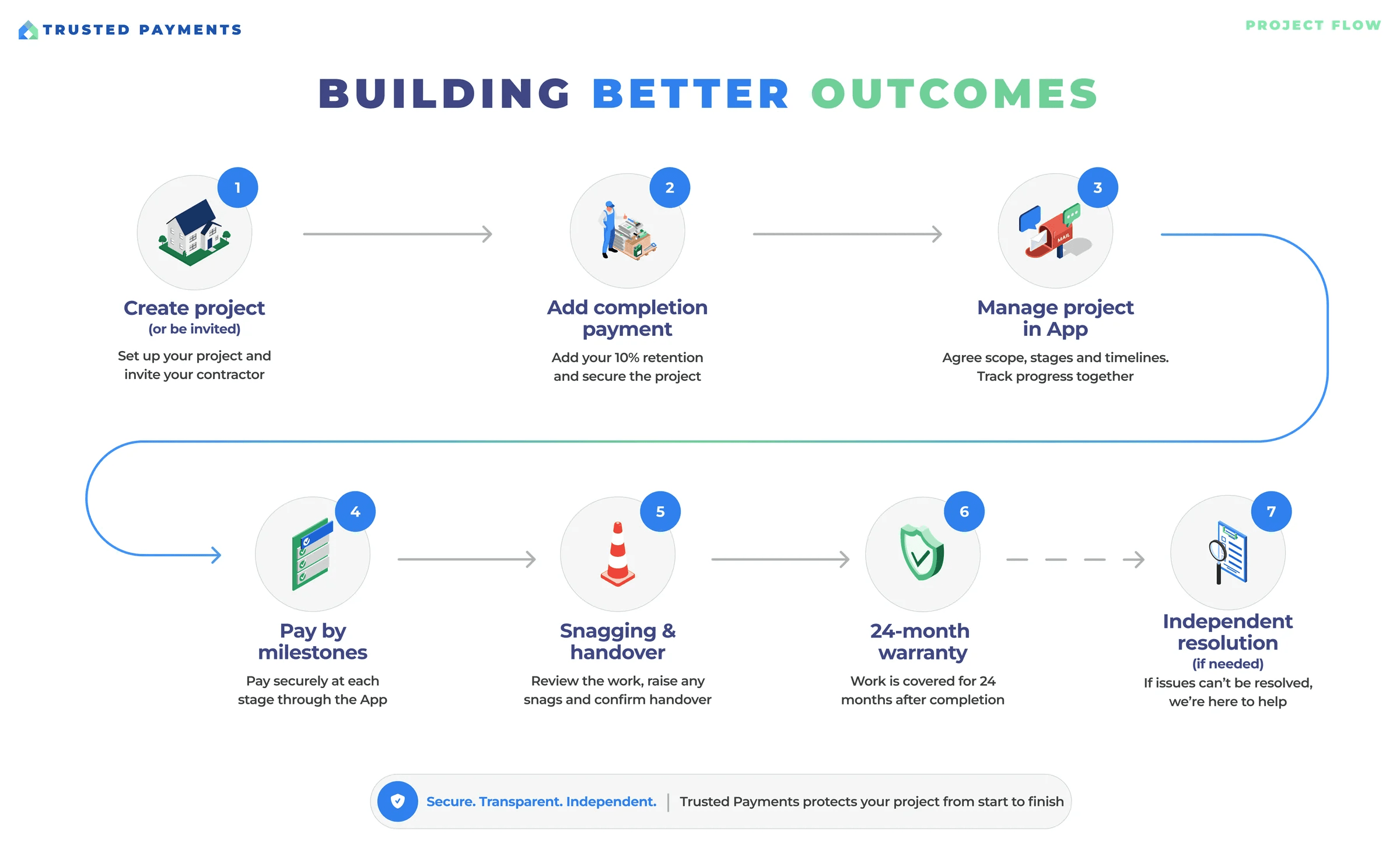
How it works
Help your project succeed with Trusted Payments
Related guides
Common questions
- Will it stop my sale?
- It can. Most cases resolve through indemnity insurance or regularisation.
- Is indemnity insurance enough?
- For the sale, usually. For safety, no.
- Can I be made to demolish?
- Possible where planning enforcement is taken, particularly for unlawful extensions.
- What about listed buildings?
- Different and more serious, unauthorised work is a criminal offence.