How Much Does a New Kitchen Cost?
Written by James Walker · Last reviewed 15 August 2026
James Walker has 2 degrees in construction (BSc (Hons) Building Surveying · MSc Environmental Design of Buildings) and an extensive background in issue resolution, resolving over £4 billion of consumer issues.
The short answer
- A standard full kitchen typically costs £10,000–£20,000.
- Units are usually less than half the total. Worktops, appliances and labour make up the rest.
- Worktop material is the single largest swing factor in most kitchens.
- Moving services, sink, hob, waste, costs disproportionately more than it appears to.
- Prices last updated August 2026.
On this page
Cost by scope
| Scope | Typical range |
|---|---|
| Flat-pack, fitted | £5,000–£10,000 |
| Rigid units, fitted | £10,000–£20,000 |
| Premium or bespoke | £20,000–£40,000 |
Cost by item
| Item | Typical range |
|---|---|
| Units - flat-pack, supply only | £1,500–£3,500 |
| Units - rigid, supply only | £3,000–£7,000 |
| Units - bespoke, supply only | £8,000–£25,000 |
| Worktop - laminate | £200–£400 per linear m fitted |
| Worktop - quartz | £400–£700 per linear m fitted |
| Worktop - granite | £500–£900 per linear m fitted |
| Fitting labour | £1,500–£3,500 |
| Island - units and worktop | £1,500–£4,000 |
| Wall removal / layout change | £3,000–£8,000 |
What pushes the price up
Worktop material. The gap between laminate and stone is often the largest single decision in the whole project, and it is made late, when the budget is already committed.
Moving the sink or hob. Relocating waste, water and gas means work under floors and through walls. Keeping the layout roughly where it is saves substantially.
Appliance specification. Integrated appliances cost more than freestanding and need units built around them. This is where budgets quietly expand.
Trade count. A kitchen touches electrics, plumbing, gas, tiling, flooring and decorating. Each is a cost, and coordinating them is a cost too, whether or not it appears as a line.
Making good. Removing an old kitchen exposes damaged plaster and unfinished flooring. If the quote excludes plastering and decorating, that is a real cost arriving later.
Structural changes. Removing a wall to open the space adds a structural element, building control, and a different project entirely.
How long it takes
10–20 days, plus the gap between unit installation and worktop fitting where stone is templated.
Regional differences
| Region | Labour multiplier |
|---|---|
| London | ×1.20–1.35 |
| South east | ×1.15–1.25 |
| Midlands | ×1.00 |
| North | ×0.85–0.95 |
| Scotland | ×0.85–0.95 |
| Wales | ×0.85–0.95 |
| Applies to labour, not materials. Sources cluster on London +20-35% and North -10-15%. Damp proofing sources gave a narrower London premium of +15-25%. |
How to stage the payments
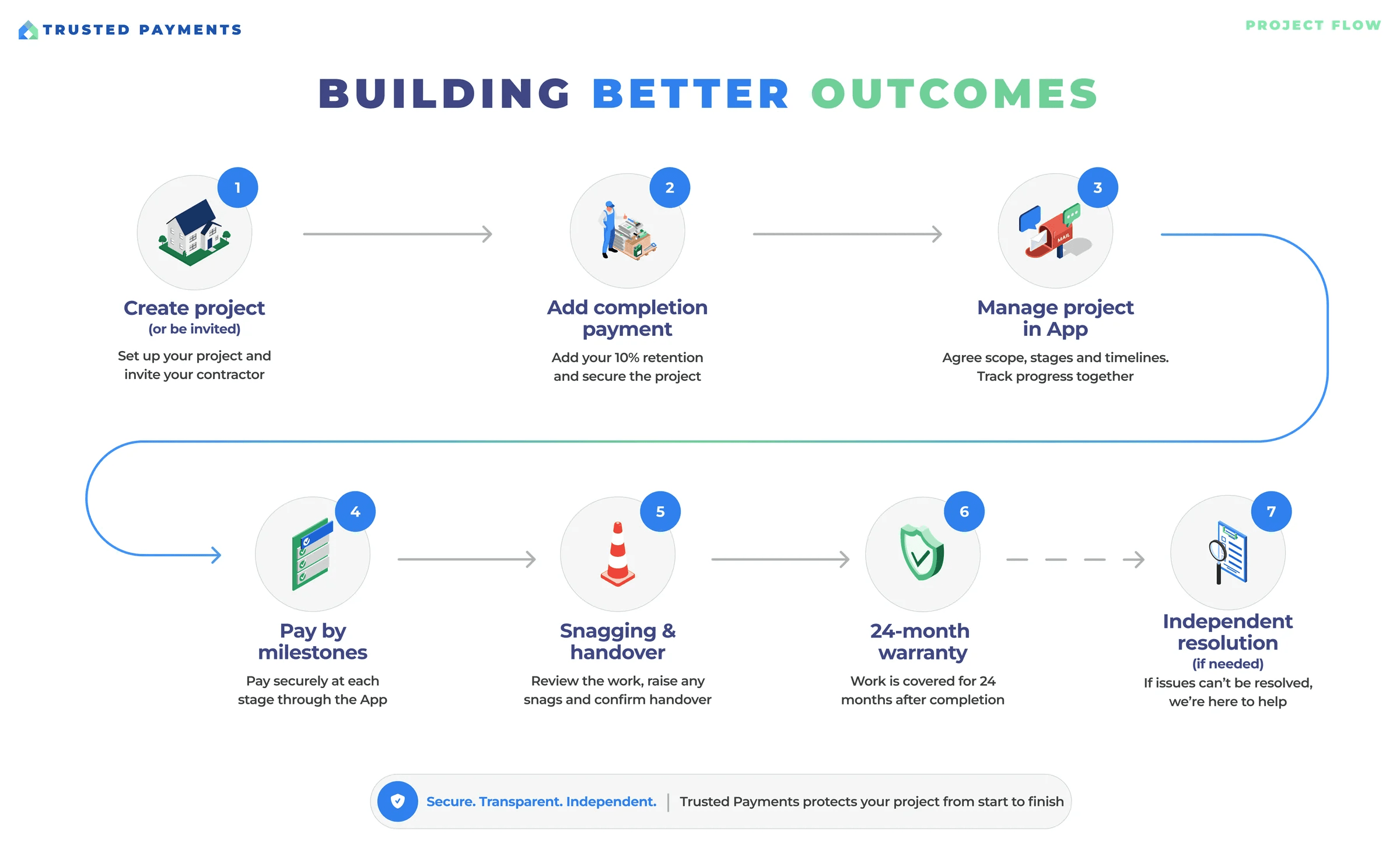
Completion payment set aside, then a kick-off of 25-30%, ideally paid to the unit supplier directly, so you own the goods. After that: units delivered and checked, old kitchen removed and first fix, units installed, worktops fitted, then final on completion. Hold the final 10% until worktops are in and everything has been tested.
Keeping the cost down
- Keep the sink and hob roughly where they are
- Standard carcasses with better doors gives most of the effect for less
- Choose worktop before finalising the budget, not after
- Confirm whether making good is included before comparing quotes
How it works
Help your project succeed with Trusted Payments