
My Builder Has Gone Bust Mid-Job
Written by James Walker · Last reviewed 15 August 2026
James Walker has 2 degrees in construction (BSc (Hons) Building Surveying · MSc Environmental Design of Buildings) and an extensive background in issue resolution, resolving over £4 billion of consumer issues.
The short answer
- Stop all payments immediately, including any standing arrangement.
- Money already paid to an insolvent company is usually very hard to recover.
- How you paid matters, card payments may offer a route that transfers do not.
- Check whether any guarantee or warranty is insurance-backed, because that survives the company.
- Record the state of the work before anyone else touches it.
On this page
First steps
Stop paying. If there is any recurring arrangement, cancel it today.
Then confirm what has actually happened. Companies enter several different insolvency processes, and they are not the same. The public register will show the position and, usually, who has been appointed to handle it.
Photograph and document the site thoroughly before a replacement trade starts.
What happens to money you have paid
This is the difficult part, and it is better to know it plainly.
When a company becomes insolvent, its assets are distributed under a legal order of priority. Consumers who have paid for work not yet done are generally near the back of that queue, and often receive little or nothing.
This is not a reflection of the fairness of your claim. It is how insolvency works.
Routes that may still exist
Card payments. Often the strongest remaining option for larger sums. Contact your provider promptly.
Insurance-backed guarantees. If the work came with one, it is underwritten by an insurer rather than the builder, so it can survive the company's failure. Find the paperwork.
Deposit protection through a scheme. Some accreditation schemes offer protection. Check whether your builder was a member.
Directly-owned materials. If you paid a supplier yourself, those goods may be yours rather than the company's.
Finishing the work
Expect to pay more than the outstanding balance. Taking over part-finished work carries risk, and builders price for it, some will decline entirely.
Get any part-complete structural or notifiable work inspected before it is covered up. Building control sign-off does not disappear because the original builder did, and unresolved sign-off causes problems when you come to sell.
How it works
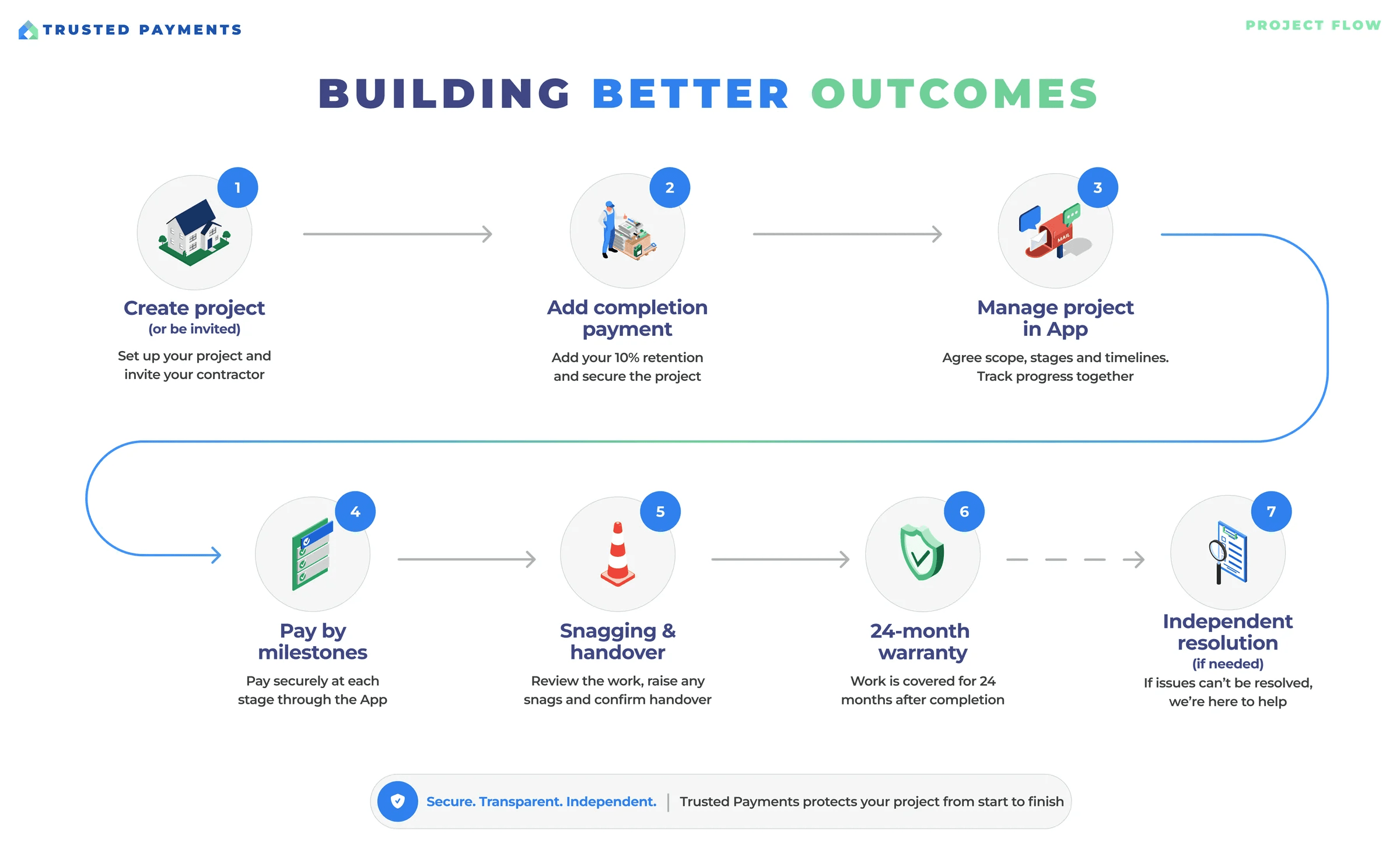
Help your project succeed with Trusted Payments
Related guides
Common questions
- Can I claim against the director personally?
- Usually not, but there are exceptions. Take advice.
- What about the guarantee?
- Only if it is insurance-backed. A guarantee from the company itself goes with the company.
- Should I register as a creditor?
- Yes. It costs little and preserves your position.
- Can I keep materials on site?
- Depends on who owns them. Ask the insolvency practitioner before removing anything.