
My Builder Took My Deposit and Disappeared
Written by James Walker · Last reviewed 15 August 2026
James Walker has 2 degrees in construction (BSc (Hons) Building Surveying · MSc Environmental Design of Buildings) and an extensive background in issue resolution, resolving over £4 billion of consumer issues.
The short answer
- Contact them in writing first. Keep everything, it matters later in a way phone calls do not.
- Check whether the company still trades and whether it is the entity you actually paid.
- How you paid determines your options. Card payments have routes that bank transfers do not.
- Recovery is genuinely difficult once money has moved. Be prepared for that.
- If they are a member of an accreditation scheme or ombudsman, that route is usually faster than court.
On this page
First, before assuming the worst
Some disappearances are not disappearances. Illness, an overrunning previous job, or a family crisis all look identical from your side for a fortnight.
Send one clear written message: what you paid, when, what was agreed, and a specific date by which you need a response. Keep it factual. If there is an innocent explanation, this usually surfaces it.
Working out who you actually paid
Check the name on your payment against the name on the quote. If you paid a personal account for work quoted by a limited company, that matters. Look the company up, whether it is still trading, and whether it has changed name or been dissolved.
This determines who you can pursue, and it is worth doing before you spend money on anything else.
Your options, depending on how you paid
Credit card. Often the strongest position for larger payments. Contact your card provider.
Debit card. There may be a route through your bank. Ask specifically about a chargeback.
Bank transfer. The hardest. Report it to your bank immediately anyway, speed matters, and there are circumstances where banks reimburse.
Cash. Very difficult without a receipt.
Escalating
If the builder belongs to an accreditation scheme or an ombudsman, use it. It is faster and cheaper than court, and the leverage of scheme membership sometimes resolves things on its own.
Beyond that, the small claims route exists for smaller sums and does not need a solicitor. Be realistic: winning a judgment and collecting money are not the same thing, particularly against a dissolved company.
The honest part
Money that has gone is often hard to get back. Nobody in this situation wants to hear that, but it is why the structure of payments matters so much more than knowing the recovery steps.
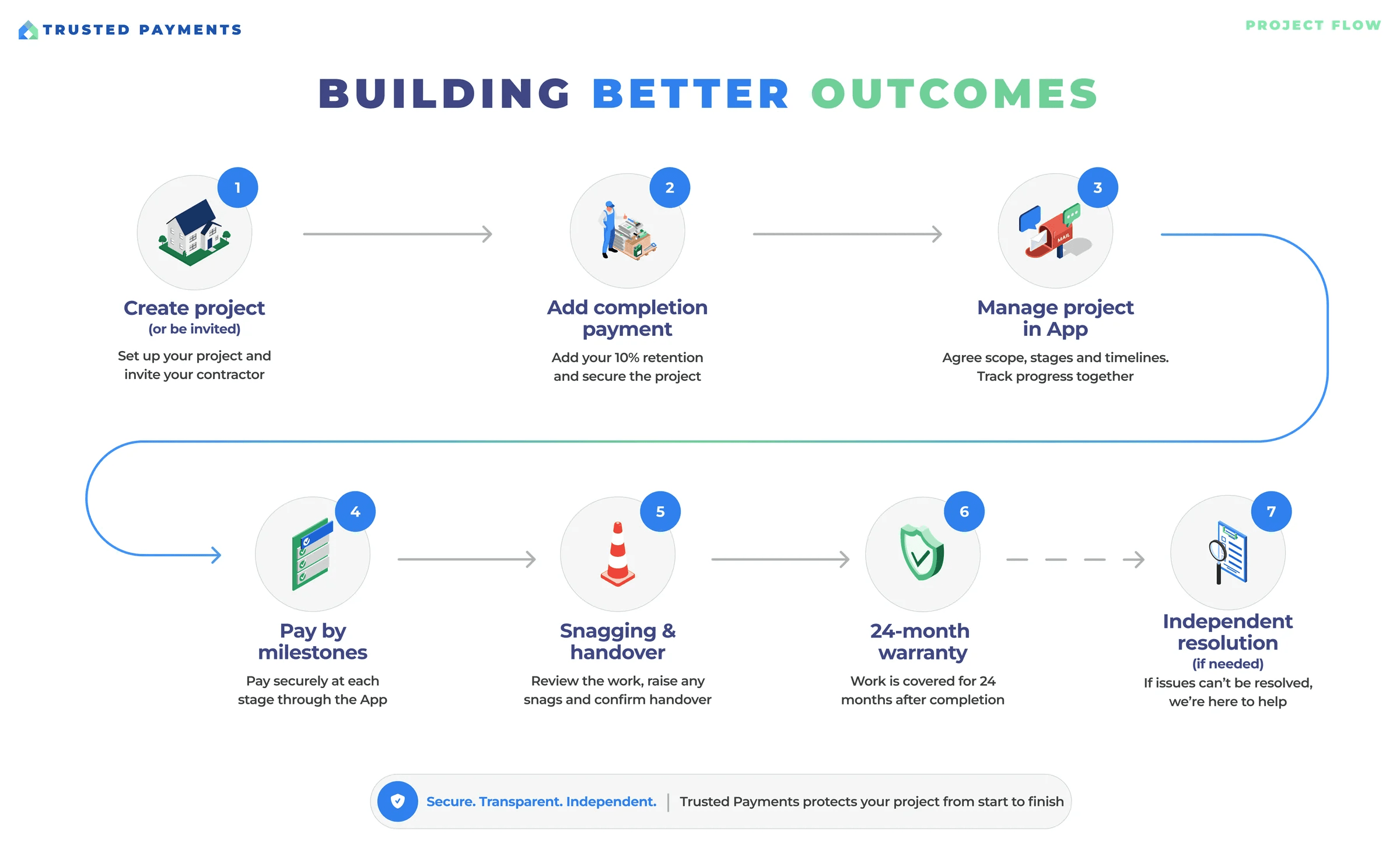
If you are reading this before paying anyone, the practical lesson is: keep the up-front amount small, tie the rest to work you can see, and hold something back until the end.
How it works
Help your project succeed with Trusted Payments
Related guides
Common questions
- How long before I should worry?
- A week of no contact after a missed start date is enough to escalate.
- Should I report it to Trading Standards?
- Yes, it may not recover your money but it builds the case against repeat offenders.
- Can I get the deposit back if they bought materials?
- Possibly in part. Ask for the invoices and where the materials are.
- Is it worth going to court?
- Depends on the sum and whether the company still exists.