
What Deposit Should You Pay a Builder?
Written by James Walker · Last reviewed 15 August 2026
James Walker has 2 degrees in construction (BSc (Hons) Building Surveying · MSc Environmental Design of Buildings) and an extensive background in issue resolution, resolving over £4 billion of consumer issues.
The short answer
- Most builders do ask for a deposit before starting. That is normal and not a warning sign on its own.
- A reasonable deposit covers materials the builder buys up front, plus holding your slot, so it varies a great deal by trade.
- It should never be half the job, and never the whole job.
- Pay the rest in agreed stages, as each part of the work is finished and you have checked it.
- If a builder won't explain what the deposit is for, that is the warning sign, not the deposit itself.
On this page
Why builders ask for a deposit
A deposit is not a trick. Most builders are small businesses without the cash to buy your materials out of their own pocket and wait weeks to be paid back. On a kitchen or a bathroom, the units, tiles and fittings often have to be ordered and paid for before anyone lifts a tool.
There is a second reason, and builders are usually less direct about it. A deposit holds your place in the diary. If you cancel a week before, they have an empty fortnight they cannot fill. The deposit is what stops that being a free option for you.
So the question is not whether to pay a deposit. It is how much, and what happens to it.
How much is reasonable
The test that works on almost any job: does the deposit roughly match what the builder has to spend or commit to before starting?
That means a small repair with off-the-shelf materials should carry a small deposit or none at all. A kitchen with made-to-order units, or a bathroom with a specified suite on lead time, reasonably carries more, because the money genuinely leaves the builder's account before they arrive.
What should make you pause is a deposit that bears no relationship to the materials. If someone quotes for a job needing very little bought up front and asks for a third of the total, ask what the money is for. A straight answer is easy to give if there is one.
Which is why a single national "normal deposit" figure is misleading. What is reasonable depends almost entirely on what the trade has to buy before they arrive:
| Type of job | Reasonable deposit | Examples |
|---|---|---|
| Labour with few materials | None | Plastering, decorating, tiling where you supply, damp treatment |
| Modest stock materials | Around 10% | Rewiring, plumbing, flooring, fencing |
| Significant standard materials | 15-20% | Bathrooms, boilers, re-roofing, solar, driveways |
| Made to measure, not returnable | 25-30% | Kitchens, windows and doors, bespoke joinery |
Two things follow. A plasterer asking for 25% up front has no material reason for it. And a kitchen company asking for 25% probably does, but that money should be tied to the units being ordered, not handed over as a lump sum.
Above 30%, on any domestic job, there is no ordinary explanation.
What a deposit should never be
- Half the job. There is no version of a normal domestic project where half the money is needed before work starts.
- The full amount. Once it is all paid, you have nothing left to hold anyone to.
- Cash with no record. If there is no paper trail, you have no proof you paid.
- A discount for paying now. Urgency pricing is a pressure tactic. A real discount does not expire this afternoon.
- Paid to a personal account when you are contracting with a limited company. Ask why before you send anything.
Paying the rest in stages
The deposit is only half the question. What protects you is how the rest is paid.
Agree the stages before work starts, in writing, with an amount against each one. On a bathroom that might be first fix, then tiling, then second fix and finish. On an extension it might follow foundations, walls, roof, then internal work. Each stage should be something you can actually look at and judge as done.
Then hold back a final amount until everything is finished properly, including the snagging. That last payment is your only real leverage once the work is nearly complete, and handing it over early is the most common way people lose it.
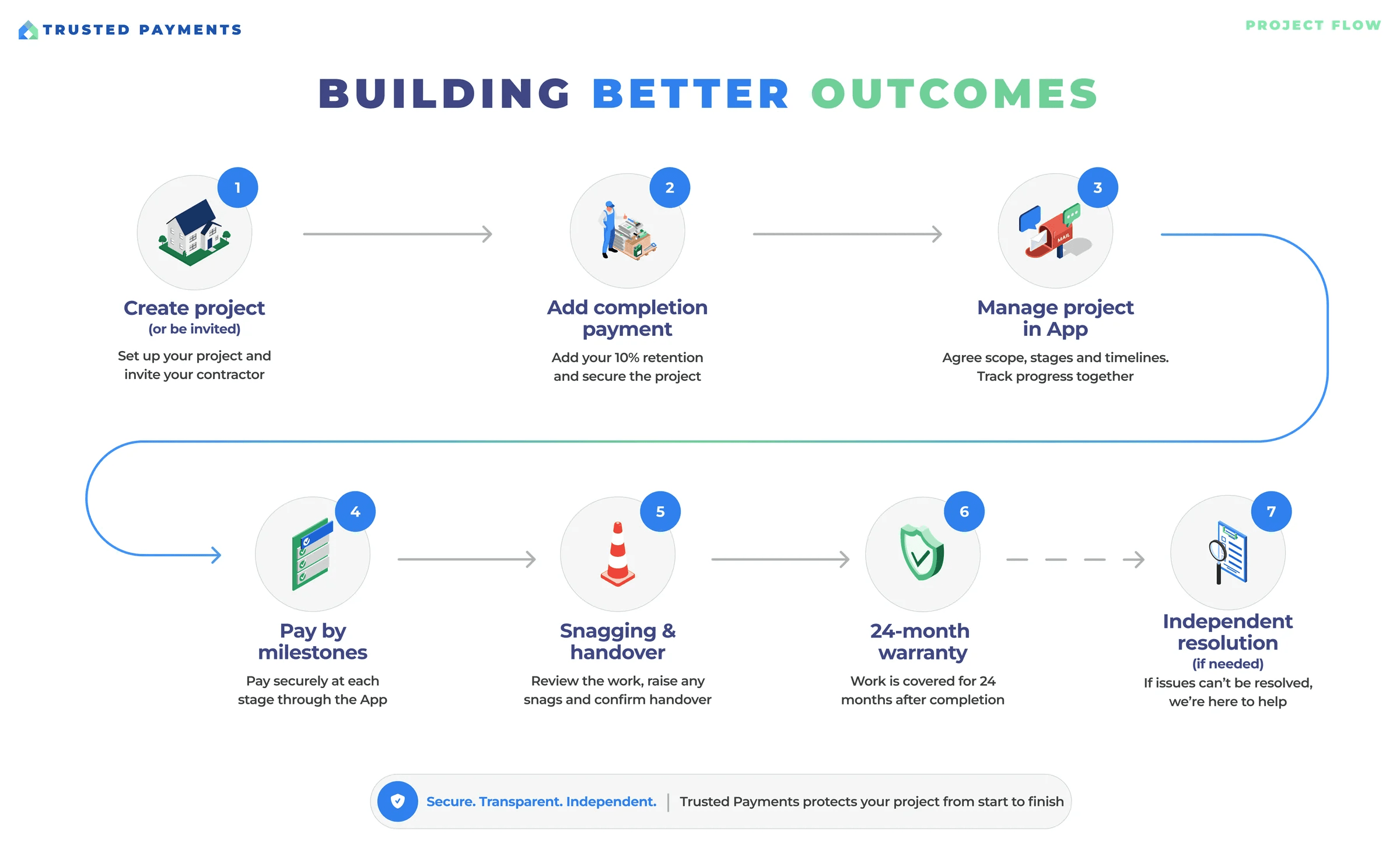
This is what Trusted Payments does, and it changes the order things happen in. The 10% completion payment is set aside first and held back until the job is genuinely finished. Whatever the trade needs to get started is then paid as a kick-off, capped by the type of work, never above 30%. Everything after that is released stage by stage, as you sign each one off.
So the money most at risk in a conventional arrangement, the deposit, is capped, and the money that gives you leverage at the end is already protected before anyone starts. There is also a 24-hour window after you approve a payment, so a decision made in a hurry can still be reconsidered.
What to get in writing
Before any money changes hands:
- The total price, and whether it includes VAT
- What is included and, more usefully, what is not
- The payment stages, with an amount against each
- Start date and expected finish date
- Who removes waste
- What happens if the price changes, and how that gets agreed
- The company's full legal name and registered address
If a builder resists putting the payment stages in writing, that tells you something worth knowing before you pay them anything.
What to do if it goes wrong
If a builder takes a deposit and does not start, contact them in writing first and keep the reply. Written records matter later in a way that phone calls do not.
If that fails, your route depends on how you paid. A card payment may give you a route through your bank. A bank transfer is much harder to recover, which is the practical reason not to send large sums that way.
Be aware that recovering money after it has gone is genuinely difficult. That is why the structure of the payments matters more than knowing what to do afterwards.
How it works
Help your project succeed with Trusted Payments
Related guides
Common questions
- Is a builder's deposit refundable?
- It depends on what it covered and what your agreement says. If materials have been bought, expect that part not to come back.
- Should I pay cash for a discount?
- No. You lose the record, and often the VAT position and any guarantee with it.
- What if the builder asks for more money partway through?
- Ask what changed and get it agreed in writing before paying. Mid-job requests for unplanned money are a common warning sign.
- Do I need a written contract for a small job?
- Yes, even a short email confirming price, scope and dates.
- Is it normal to pay suppliers directly?
- Sometimes, for expensive items. It can work in your favour, since you own the goods.