
My Building Work Is Running Late
Written by James Walker · Last reviewed 15 August 2026
James Walker has 2 degrees in construction (BSc (Hons) Building Surveying · MSc Environmental Design of Buildings) and an extensive background in issue resolution, resolving over £4 billion of consumer issues.
The short answer
- Some overrun is normal. Weather, materials and hidden problems all cause genuine delay.
- Where no completion date was agreed, the work must still be done within a reasonable time.
- Ask for a revised written schedule rather than a general reassurance.
- Do not release payments early to speed things up. It removes your only leverage.
- Persistent delay with no explanation is usually a sign the builder is working elsewhere.
What counts as a real delay
Almost every project overruns to some degree, and a fortnight on a three-month job is not a crisis. What matters is whether the delay is explained, and whether anyone is actually on site.
The pattern worth worrying about is not slowness, it is absence. A builder making slow progress is still working on your job. A builder appearing for a morning a week has moved on to another and is keeping yours warm.
Where you stand
If you agreed a completion date, that is what the builder committed to.
If you did not, the work must still be carried out within a reasonable time. What is reasonable depends on the job, its size, complexity, and what has genuinely got in the way.
Anything the builder told you before you hired them can also count, including verbal assurances about how long it would take.
What to do
Ask for a revised schedule in writing. Not "soon" or "a couple more weeks", dates against the remaining stages. A builder who can produce one is usually still engaged with your job. One who cannot, or will not, is telling you something.
Keep paying to the agreed stages, and no faster. The single most common mistake here is releasing money early in the hope it speeds things up. It reliably does the opposite: once a builder is paid ahead of the work, your job becomes the least urgent thing in their week.
Write down the impact. If the delay is costing you money, storage, alternative accommodation, a rescheduled trade, record it as it happens.
When it stops being a delay
At some point a delay becomes an abandoned job. There is no fixed line, but the practical markers are: no one on site for several weeks, no revised schedule despite being asked in writing, and no response to messages.
At that point, treat it as abandonment rather than lateness, because the steps are different.
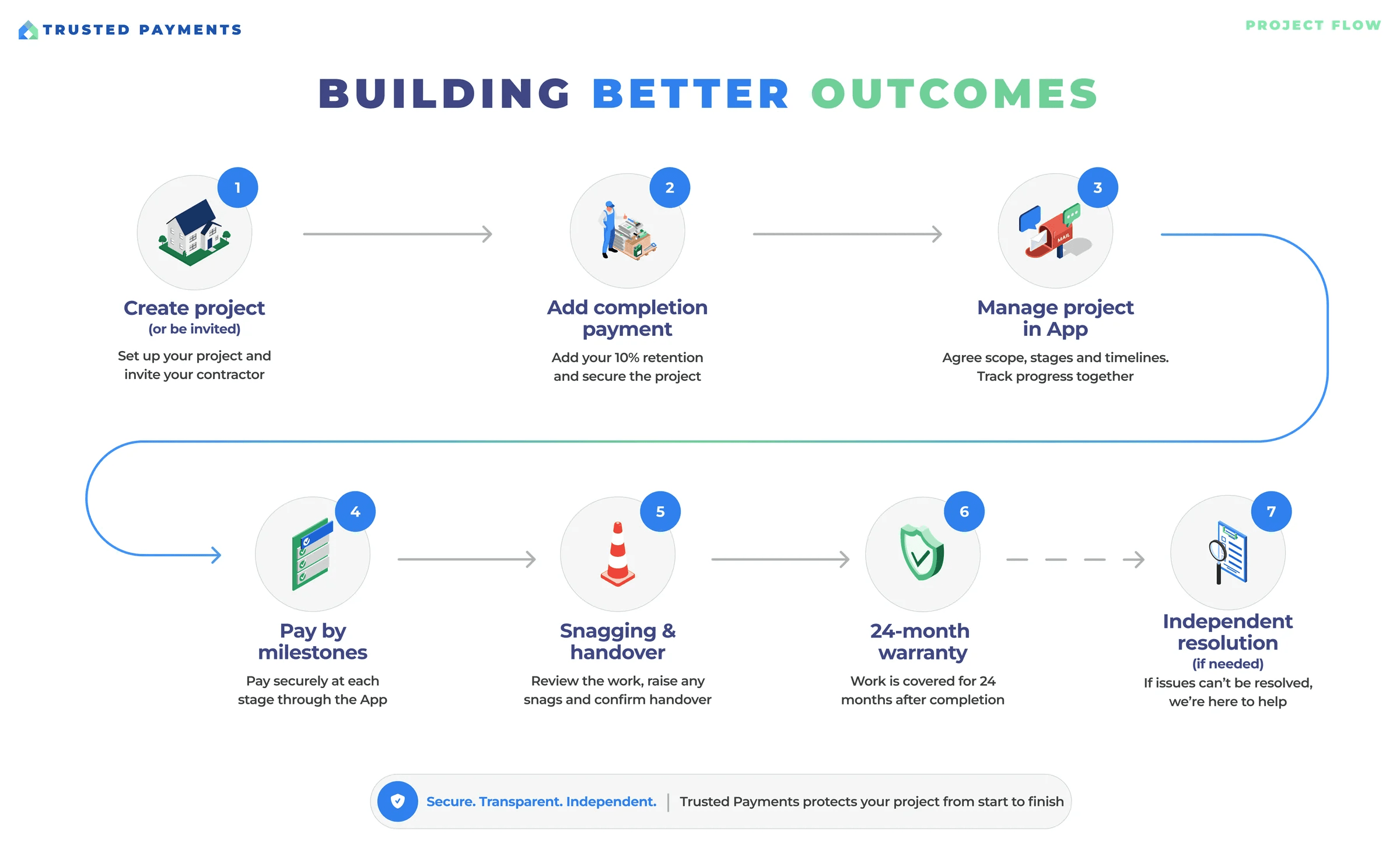
How it works
Help your project succeed with Trusted Payments
Related guides
Common questions
- Can I claim for the cost of the delay?
- Sometimes, particularly where a date was agreed. Keep records and take advice.
- Can I set a new deadline myself?
- You can set a reasonable one in writing. Make it realistic, an unreasonable deadline weakens your position.
- What if bad weather caused it?
- Weather is a genuine cause for external work. It does not explain months of absence.
- Should I find another builder?
- Not while the first is still engaged, unless you have taken advice, you may still be contractually committed.