How to Hire a Fencing Contractor
Written by James Walker · Last reviewed 15 August 2026
James Walker has 2 degrees in construction (BSc (Hons) Building Surveying · MSc Environmental Design of Buildings) and an extensive background in issue resolution, resolving over £4 billion of consumer issues.
The short answer
- Establish whose boundary it is before doing anything. This is the main cause of trouble.
- Height limits apply, and are lower next to a highway. Exceeding them may need permission.
- How posts are fixed determines how long the fence lasts.
- Talk to the neighbour before work starts, even where the boundary is clearly yours.
- Deposits should be small, materials are standard and readily available.
On this page
What makes hiring a fencing contractor different
The technical work is straightforward. The problems are almost entirely about boundaries and neighbours.
Fences get erected on the wrong line, or replaced by someone who does not own them, and the resulting dispute lasts far longer and costs far more than the fence.
Boundary ownership
Check your title deeds or plan. Ownership is often indicated, though not always definitively.
If it is unclear, speak to the neighbour before starting rather than after. A fence erected on a disputed line may have to come down.
Where it is the neighbour's fence, you cannot simply replace it, though you can usually put your own up inside your boundary.
Height and permissions
The limits are specific. A fence, wall or gate can go up to 2 metres above ground level without planning permission. Next to a highway used by vehicles, or the footpath of one, the limit drops to 1 metre.
Two things catch people out. The height includes any trellis or topper, a 1.8m fence with a 30cm trellis is a 2.1m fence and needs permission. And on a corner plot, the side boundary running along the road is in the 1-metre zone too.
Listed buildings, conservation areas and Article 4 directions all change this. Replacing an existing over-height fence like for like is generally allowed, but not in a conservation area or a listed building's grounds.
Posts and longevity
Fences fail at the posts. Ask what is being used, timber, concrete, or metal spikes, and how they are set. Concreted posts last considerably longer than driven spikes in most ground.
Ask about timber treatment and gravel boards, which keep panels clear of wet ground.
Deposits and payment stages
Materials are standard and cheap to obtain, so no deposit should be needed. For most fencing, payment on completion is reasonable.
Questions to ask
- Whose boundary is this, and have you checked the line?
- What height are you building, and does it need permission?
- What posts are you using and how are they set?
- Are gravel boards included?
- What happens to the old fence and its posts?
How it works
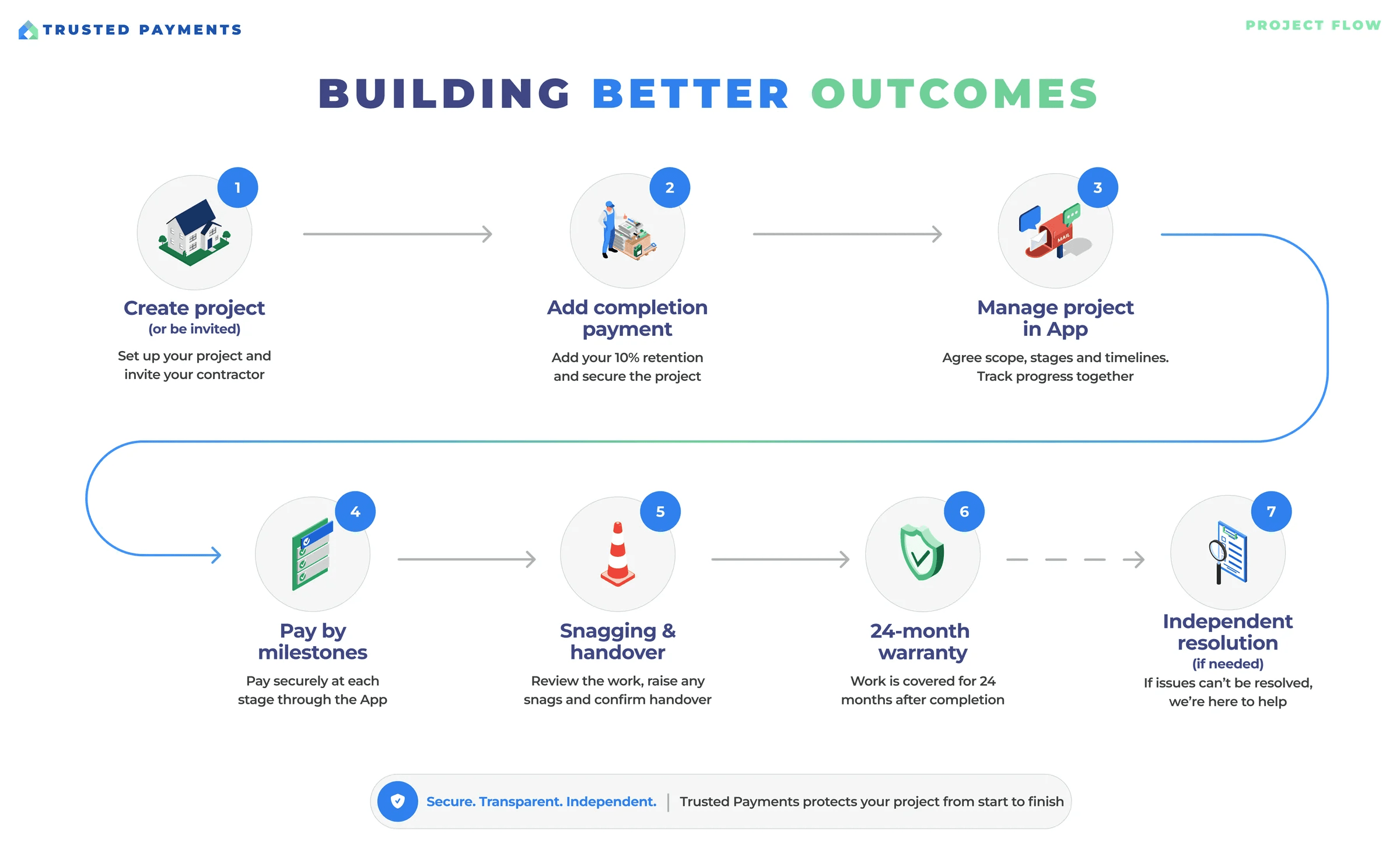
Help your project succeed with Trusted Payments