
What Do Builder Accreditation Schemes Actually Mean?
Written by James Walker · Last reviewed 15 August 2026
James Walker has 2 degrees in construction (BSc (Hons) Building Surveying · MSc Environmental Design of Buildings) and an extensive background in issue resolution, resolving over £4 billion of consumer issues.
The short answer
- Some registrations are legally required. Others are voluntary quality schemes. The difference matters.
- Gas work legally requires Gas Safe registration. Certain electrical work is notifiable under Building Regulations.
- Voluntary schemes vary widely in how much checking they actually do.
- Always verify membership on the scheme's own register, never on the builder's website.
- Accreditation lowers your risk. It does not remove it.
On this page
[VERIFY, check this page against your current partner agreements, particularly anything said about fast-track routes.]
Legally required registration
Gas Safe Register. Anyone carrying out gas work must be registered. This is law, not a quality mark. Ask to see the card, check the register, and confirm the specific work is within what they are qualified for, the card lists categories.
Electrical work and Part P. In England and Wales, certain domestic electrical work is notifiable under the Building Regulations. Electricians registered with a competent person scheme can self-certify their work; otherwise it must be notified to building control. Schemes include NICEIC and NAPIT.
If work that needs certification does not get it, the problem surfaces when you sell.
Voluntary quality schemes
TrustMark is a government-endorsed quality scheme covering work in and around the home, with member firms checked against defined standards.
Buy with Confidence is run through Trading Standards, with members vetted before approval.
Book a Builder is a directory with its own vetting of listed firms.
Trade-specific bodies include the NFRC for roofing and MCS for renewable technologies such as solar. Membership generally involves an assessment against that trade's standards.
[VERIFY, confirm the current descriptions of the three partner schemes above.]
What accreditation actually gives you
Three things, roughly.
A filter. Someone has checked the business before you did, insurance, trading history, sometimes workmanship.
A complaints route. Most schemes offer a dispute process, which is faster and cheaper than court and often produces a response where direct contact has not.
Leverage. A builder with membership to lose behaves differently from one with nothing at stake.
What it does not give you
Accreditation does not guarantee the work. Scheme members produce defective work, run late, and occasionally fail as businesses.
It also does not mean recent checking. Schemes vary in how often they reassess, and a firm can have declined considerably since it was approved.
And it is specific. A firm accredited for one type of work is not thereby accredited for another.
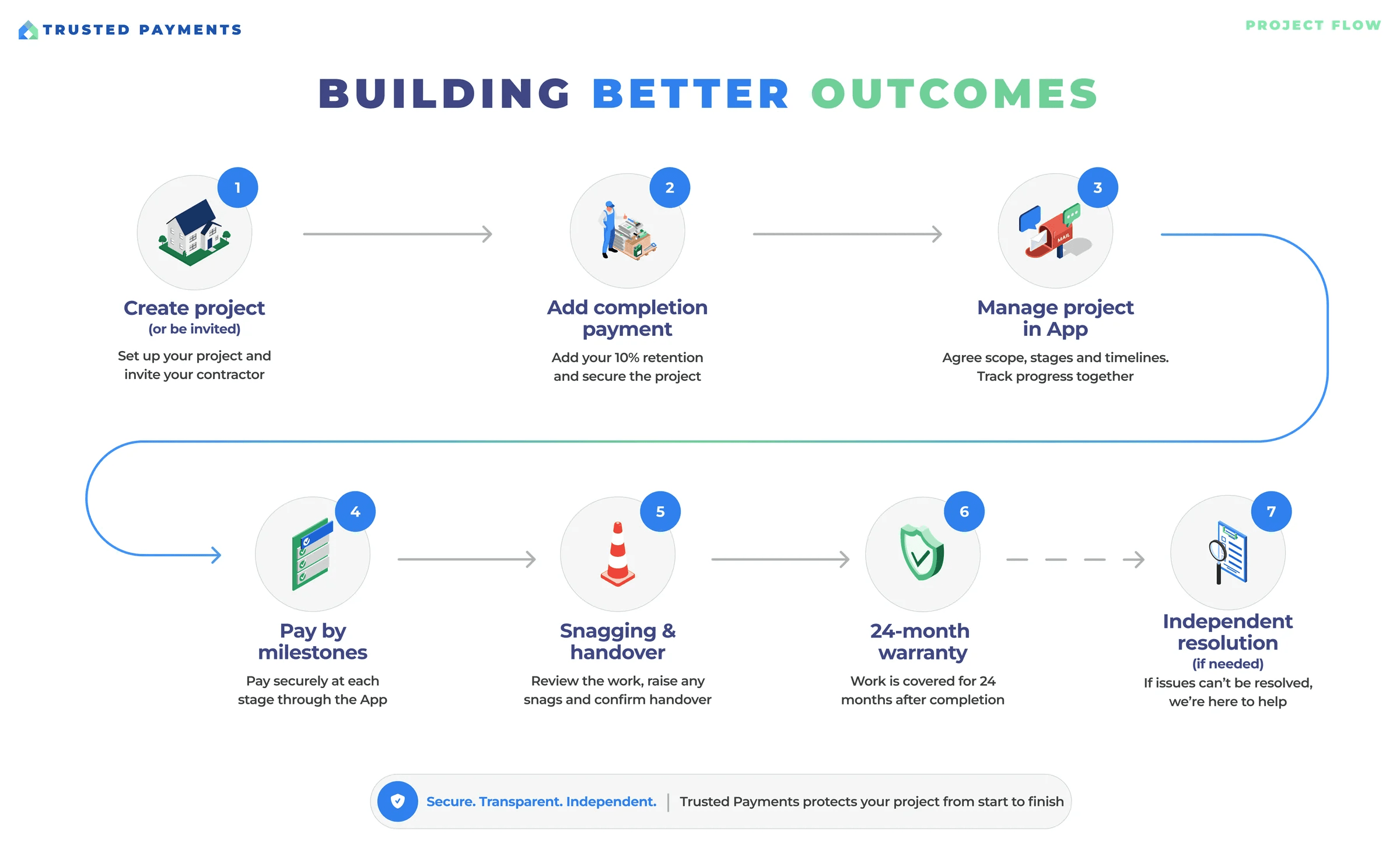
Trades arriving through TrustMark, Book a Builder or Buy with Confidence have already been vetted by those schemes, so they can start on Trusted Payments without a further check. A trade you invite yourself is vetted within three working days, subject to them responding.
How to verify membership
Go to the scheme's own website and search their register. Use the company name, not the trading name if they differ. Confirm the membership is current and covers the work you want done.
Do not rely on a logo, a certificate photograph, or a claim in a quote. All three are trivially easy to reproduce.
How it works
Help your project succeed with Trusted Payments
Related guides
Common questions
- Is a non-accredited builder a bad builder?
- No. Many excellent trades work entirely on referral. It means you do more checking yourself.
- Which scheme is best?
- They serve different purposes. What matters is that membership is current and relevant to your job.
- Does accreditation mean insurance-backed guarantees?
- Sometimes. Ask specifically rather than assuming.
- Can I check after work has started?
- Yes, and it is worth doing even then.