
What Insurance Should a Builder Have?
Written by James Walker · Last reviewed 15 August 2026
James Walker has 2 degrees in construction (BSc (Hons) Building Surveying · MSc Environmental Design of Buildings) and an extensive background in issue resolution, resolving over £4 billion of consumer issues.
The short answer
- Employers' liability is legally required if the builder has employees.
- Public liability is not legally required but protects you if your property is damaged. Any established builder will have it.
- Check the amount of cover against the value of your property, not the value of the job.
- Verify with the insurer directly. A certificate proves very little on its own.
- Your own home insurer may need to be told about substantial work.
The main types
Public liability. Covers injury to people or damage to property arising from the builder's work. This is the one that matters most to you, if a burst pipe or a collapsed section damages your home, this is what pays.
Employers' liability. Legally required where a business has employees. It covers staff injured at work. If anyone other than the owner will be on your site, ask about it.
Contract works or contractors' all risks. Covers the work itself while in progress, fire, theft, storm damage to a part-built extension. Particularly relevant on larger projects, where the exposure between starting and finishing is significant.
Professional indemnity. Relevant where someone is providing design or specification advice rather than only building. Often held by architects and designers rather than builders.
How much cover
The figure people quote is often a couple of million on public liability, but the number to think about is not the value of the job, it is the value of what could be damaged.
A small job in a large house can cause very expensive damage. Ask what the cover is, and consider whether it would rebuild your home if the worst happened.
Verifying it properly
Ask for the insurer's name, the policy number, and the renewal date. Then contact the insurer or broker to confirm the policy is live and covers the type of work being done.
This is a short phone call and it is the only check that actually proves anything. A certificate is a document; documents expire and can be altered. Legitimate builders are asked this regularly and will not be offended.
Also check the policy covers the work in question. Some exclude certain activities, hot works, roofing, or structural alterations, and an exclusion is exactly what you would discover at the worst possible moment.
Your own insurance
Tell your home insurer about substantial work. Many policies restrict or exclude cover during building work, particularly where the property is unoccupied or the structure is open.
Not telling them can invalidate cover for something entirely unrelated. It is a five-minute call that protects considerably more than the project.
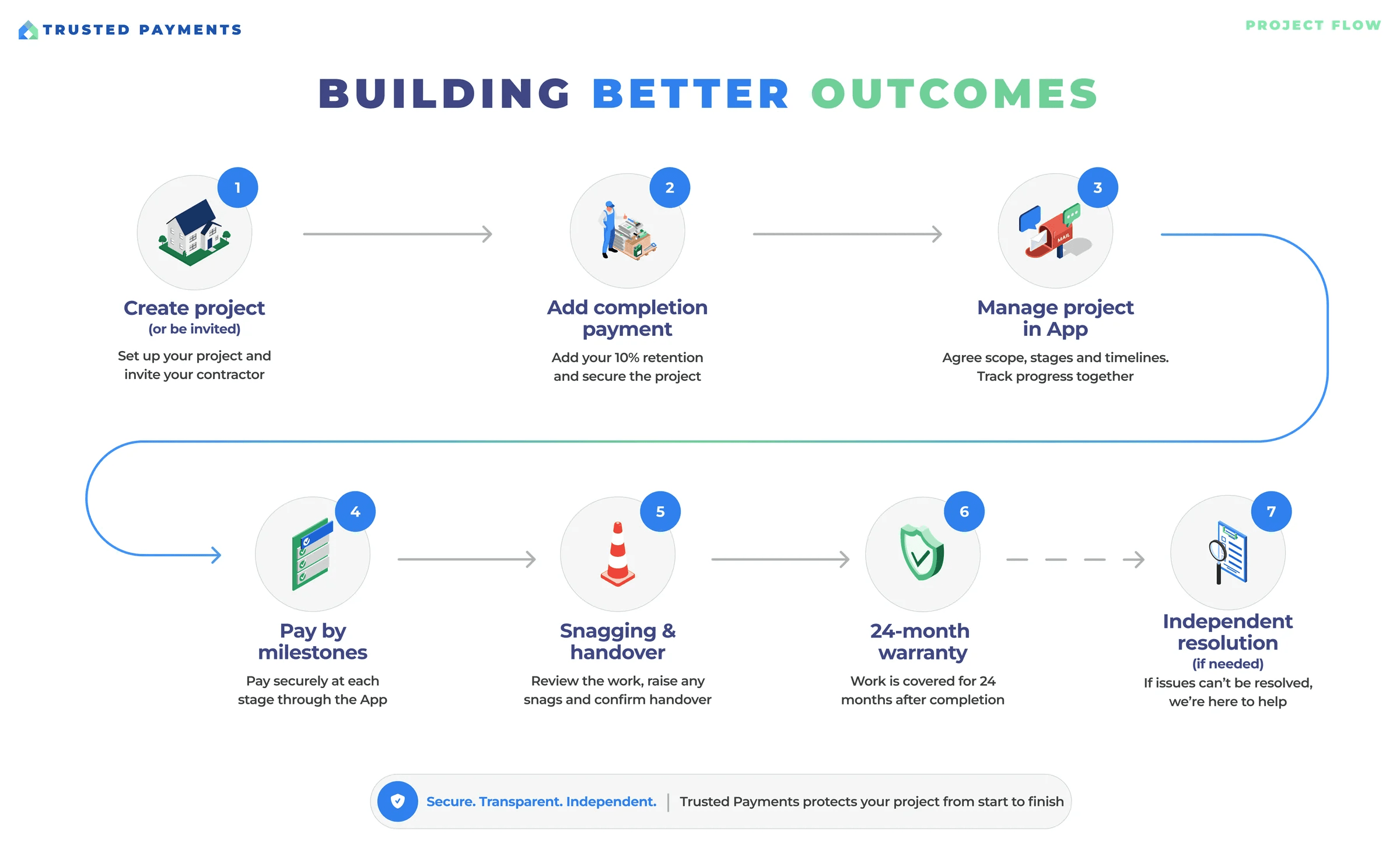
How it works
Help your project succeed with Trusted Payments
Related guides
Common questions
- Is public liability legally required?
- Not generally, but working without it on a substantial job is a serious risk to you.
- What if a subcontractor causes the damage?
- Ask who is responsible under the main builder's policy. Do not assume.
- Does their insurance cover defective workmanship?
- Usually not. Liability insurance covers damage, not the quality of the work itself.
- What if they refuse to give details?
- Treat it as a reason not to proceed.