
How to Hire a Builder
Written by James Walker · Last reviewed 15 August 2026
James Walker has 2 degrees in construction (BSc (Hons) Building Surveying · MSc Environmental Design of Buildings) and an extensive background in issue resolution, resolving over £4 billion of consumer issues.
The short answer
- These are the biggest sums and the longest timescales, so the payment structure matters more here than anywhere else.
- Establish who is managing the subcontractors, and whether that management is in the price.
- Ask what they will be working on at the same time. Most builders run several jobs.
- Scope creep is the defining risk. Agree how variations are priced before any arise.
- Building control and party wall matters need an owner. Confirm who that is.
On this page
What makes hiring a general builder different
Scale and duration. A general builder is not doing one task, they are coordinating electricians, plumbers, plasterers and others across weeks or months, with your money moving throughout.
That creates two risks that smaller trades do not carry. First, exposure over time: if things go wrong at week eight of a sixteen-week job, you have already paid a great deal for something half-built. Second, coordination failure: the builder may be competent and the job still fail because the trades arrived in the wrong order or not at all.
You are hiring project management as much as building work, and it is worth being explicit that this is what you are buying.
Registrations and accreditation
There is no single licence for general building, which is precisely why checking matters here.
Look for TrustMark or Buy with Confidence membership, verified on the scheme's register. Check that the specialist trades they bring in hold what they legally need, Gas Safe for gas, a competent person scheme for notifiable electrical work.
Confirm employers' liability cover, since a general builder almost always has people on site, and contract works cover on larger projects.
What a good builder's quote looks like
- Itemised by element, groundworks, structure, roof, first fix, second fix, finishes
- A clear statement of which trades are included and which you are arranging
- Exclusions, spelled out: making good, decoration, flooring, fittings
- Whether building control fees and applications are included
- A programme showing the sequence, not just a finish date
- Named allowances for items not yet chosen, so you know what has been assumed
The allowances point causes more arguments than anything else. If the quote assumes a certain figure for kitchen units or bathroom fittings and you then choose otherwise, that difference has to land somewhere. Better to see the number now.
Deposits and payment stages
Larger jobs mean more stages, and that works in your favour, each one is a checkpoint. It also means the deposit does not need to be large: with eight or more payment points carrying the job, around 10% up front is reasonable even on a substantial build. A large deposit on a heavily staged project is doing something other than buying materials.
Tie stages to visible structural milestones: foundations complete, walls to plate height, roof watertight, first fix complete, plastered, second fix complete. Each is something you or a surveyor can assess without specialist knowledge.
Avoid stages defined by date. On a job this long, a date-based schedule will pull you ahead of the work within a month.
What usually goes wrong
- Scope creep, a hundred small changes, none priced at the time, all argued about at the end
- The builder disappearing to another job, usually because a client there is paying faster
- Subcontractor gaps, a trade does not turn up and the whole programme stalls
- Building control problems discovered late, when work has been covered up
- Payments drifting ahead of progress, one reasonable-sounding request at a time
Questions to ask a builder
- What else will you be working on while this job runs?
- Who manages the subcontractors day to day, and is that in the price?
- Which trades are included and which am I arranging?
- Who submits and manages the building control applications?
- What allowances have you assumed for anything I have not yet chosen?
- How will variations be priced and agreed?
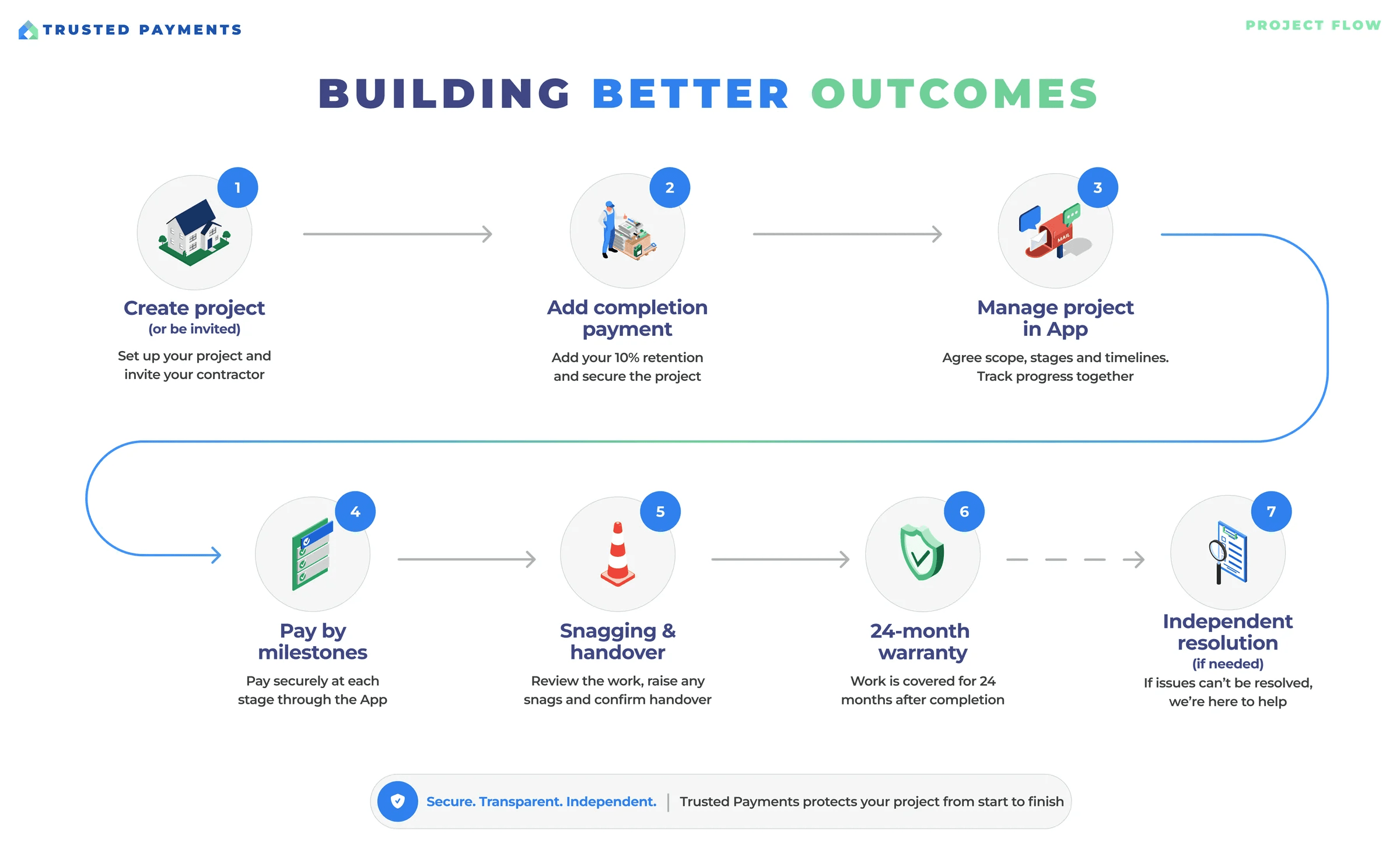
How it works
Help your project succeed with Trusted Payments
Related guides
Common questions
- Should I use a main contractor or hire trades myself?
- Managing trades yourself saves the margin and costs you the coordination. On anything structural, most people should not.
- Do I need a party wall agreement?
- Possibly, if work affects a shared wall or is near a boundary. Establish early, it takes time.
- What if the job overruns?
- Common. What matters is whether progress continues and whether payments stay tied to work.
- Should I get a surveyor?
- On larger projects, an independent eye at each stage is usually worth the fee.