
How to Hire a Solar Panel Installer
Written by James Walker · Last reviewed 15 August 2026
James Walker has 2 degrees in construction (BSc (Hons) Building Surveying · MSc Environmental Design of Buildings) and an extensive background in issue resolution, resolving over £4 billion of consumer issues.
The short answer
- Check MCS certification on the register. Without it you may lose access to export payments and grant schemes.
- Treat savings projections with real scepticism. They are the most manipulated number in this trade.
- Never sign anything on the doorstep, and never sign finance in the same conversation as the quote.
- The warranty is long and the company may not be. Ask who underwrites it.
- Your roof's condition matters. Panels on a roof needing work in five years is an expensive mistake.
On this page
What makes hiring a solar installer different
Three things set this apart from ordinary trades.
The sale is aggressive. Solar is sold, not just quoted. Doorstep visits, long in-home appointments, discounts that expire that evening, and finance offered alongside. That sales culture attracts people whose skill is closing rather than installing.
The value proposition is a projection. You are being sold future savings, which is a number the seller controls. Assumptions about energy prices, usage patterns and panel output can be adjusted until the payback looks attractive.
The promise is very long. Warranties run decades. The question is not whether the warranty exists but whether anyone will be there to honour it.
Registrations and accreditation
MCS (Microgeneration Certification Scheme) is the one that matters. To claim the Smart Export Guarantee, the payments for electricity you export, the installation must be MCS-certified, the installer must be MCS-certified, and you need a smart meter that records export. No licensed supplier will pay export income without a valid MCS installation certificate.
MCS is also the route to the Boiler Upgrade Scheme and most other grant support, and some insurers and mortgage lenders now expect to see it.
Check the MCS register directly, and confirm the certification covers solar PV specifically.
Installers should also belong to a consumer code such as RECC or HIES, which provide dispute routes and, in some cases, deposit and warranty protection.
The electrical work must be carried out competently and the installation notified appropriately, and your DNO (distribution network operator) must be notified of the connection. Ask who handles that.
Judging the numbers
Ask what the projection assumes: energy price inflation, how much generation you use directly versus export, panel degradation over time, and whether any battery is included in the payback.
Then ask for the same figures on conservative assumptions. A confident installer will provide both. One who only has the optimistic version is selling rather than advising.
Be especially careful where finance is involved. A monthly payment lower than your claimed saving sounds compelling, but the comparison depends entirely on projections you cannot verify, and the finance agreement is real regardless of whether the savings materialise.
What a good solar quote looks like
- Panel make, model, and rated output; inverter make and model
- Total system size and estimated annual generation, with assumptions stated
- Whether a battery is included, its capacity, and its separate warranty
- Scaffolding, itemised
- Roof condition assessment, and any work needed first
- Product warranty, workmanship warranty, and who underwrites each
- Who notifies the DNO and handles MCS certification paperwork
Deposits and payment stages
High-value equipment ordered in advance means deposits are normal here, 15-20% is reasonable. But this is also a trade where large up-front payments have caused significant consumer loss when companies failed, so where you can, pay the equipment supplier directly rather than the installer.
Sensible stages: deposit against equipment, scaffold and installation, commissioning and handover with certification issued. Hold the final 10% until you have the MCS certificate and the DNO notification confirmed, not when the panels are physically on the roof.
That paperwork is what makes the system eligible for export payments. Without it you have panels and no route to the benefit you bought.
What usually goes wrong
- Savings that do not materialise because the projection was optimistic
- Certification paperwork never issued, blocking export payments
- Companies dissolving, leaving decades of warranty unenforceable
- Roof damage during installation, disputed afterwards
- Finance agreements signed under pressure alongside the sale
- Batteries added late in the conversation, transforming the payback
Questions to ask a solar installer
- What is your MCS certification number, and does it cover solar PV?
- What assumptions sit behind the savings figure, and what does it look like on conservative ones?
- Who underwrites the workmanship warranty if your company ceases trading?
- What condition is my roof in, and does anything need doing first?
- Who handles the MCS certificate and DNO notification, and when will I receive them?
- Can I have the quote and consider it without the finance discussion?
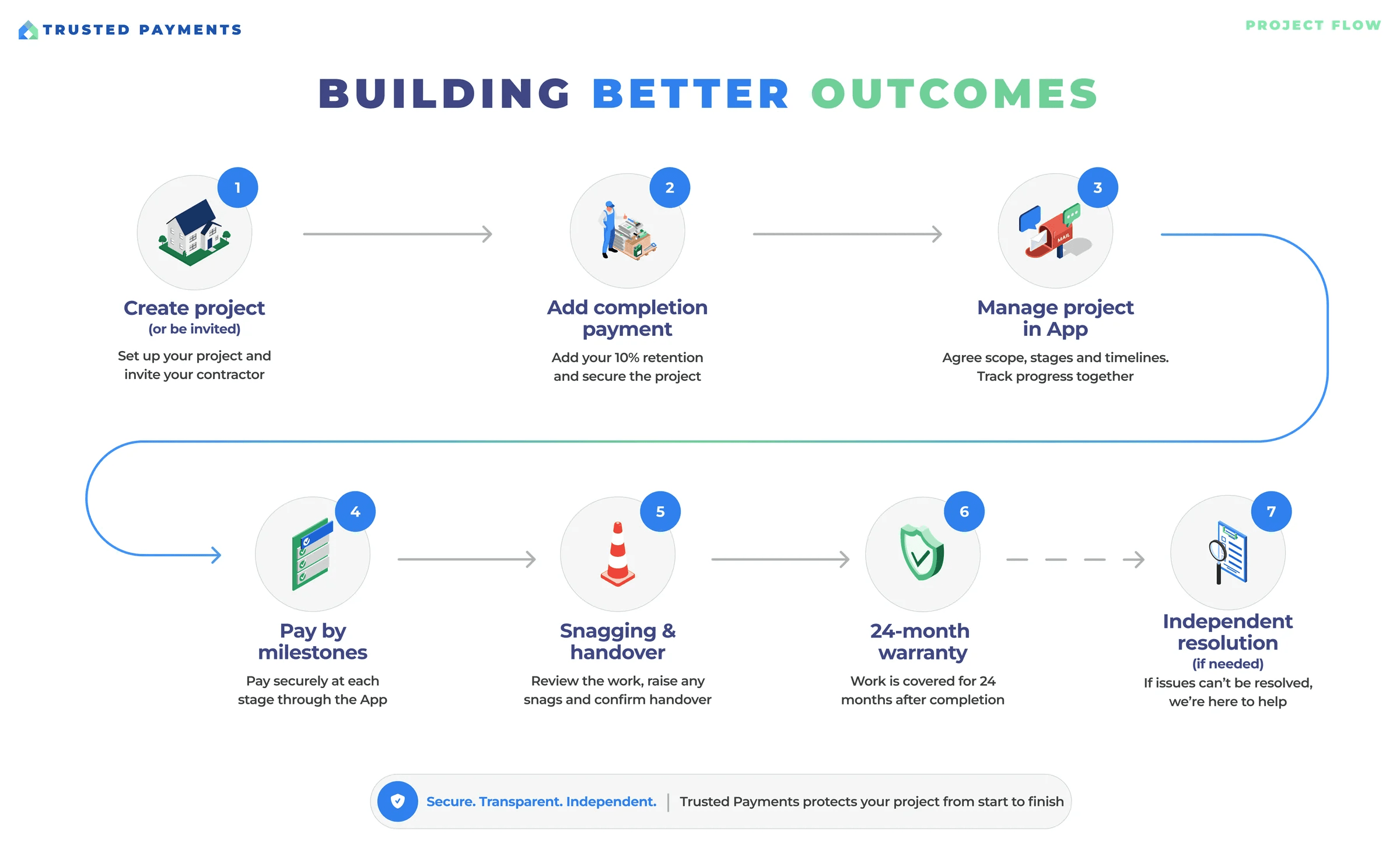
How it works
Help your project succeed with Trusted Payments
Related guides
Common questions
- Is solar worth it?
- Depends on roof orientation, usage pattern and what you pay. Get an independent view, not only the installer's.
- Do I need planning permission?
- Usually not for standard roof installations, but listed buildings and conservation areas differ. Check.
- Should I add a battery?
- It changes the economics considerably. Ask for the payback with and without.
- What if I am pressured to sign today?
- Do not. A genuine offer survives the night.