How to Hire an Extension Builder
Written by James Walker · Last reviewed 15 August 2026
James Walker has 2 degrees in construction (BSc (Hons) Building Surveying · MSc Environmental Design of Buildings) and an extensive background in issue resolution, resolving over £4 billion of consumer issues.
The short answer
- Establish who owns planning, building control and party wall before you sign anything.
- Foundations are the great unknown. Ask what happens if they need to go deeper.
- This is the longest exposure of any domestic project, so the staged structure matters most here.
- A structural engineer's design is usually needed, and is normally separate from the builder.
- Get an independent eye at each structural stage on a project this size.
On this page
What makes hiring an extension builder different
An extension is the largest and longest thing most people will ever commission, and it involves parties beyond the builder: a designer, a structural engineer, building control, possibly a planning authority and a party wall surveyor.
The defining risk is that responsibility is distributed, and gaps between the parties are where projects fail. The builder assumed the engineer's drawings covered something. The engineer assumed the architect specified it. Nobody applied for the party wall award.
Establishing ownership of each strand before work starts is the single most valuable thing you can do.
Permissions and the parties involved
Planning permission may or may not be needed, many extensions fall under permitted development, but the limits are specific and conservation areas and listed buildings differ.
Building Regulations approval is needed regardless of planning. This is separate and often confused with it.
Party wall matters arise where work affects a shared wall, or excavation happens close to a neighbour's foundation. Notice periods are meaningful and starting late delays the whole job.
Structural engineer design is normally required for openings and beams, and is usually engaged separately by you rather than the builder.
Ask explicitly who is responsible for each of these four and whether it is in the price.
Foundations, the unknown
Nobody knows what is underground until it is dug. Trees, drains, made ground and poor bearing soil can all mean foundations must go deeper than assumed.
A good quote states the assumed depth and a rate per additional metre. That converts an open-ended risk into a known number. A quote that says nothing about it is a quote that will change.
Deposits and payment stages
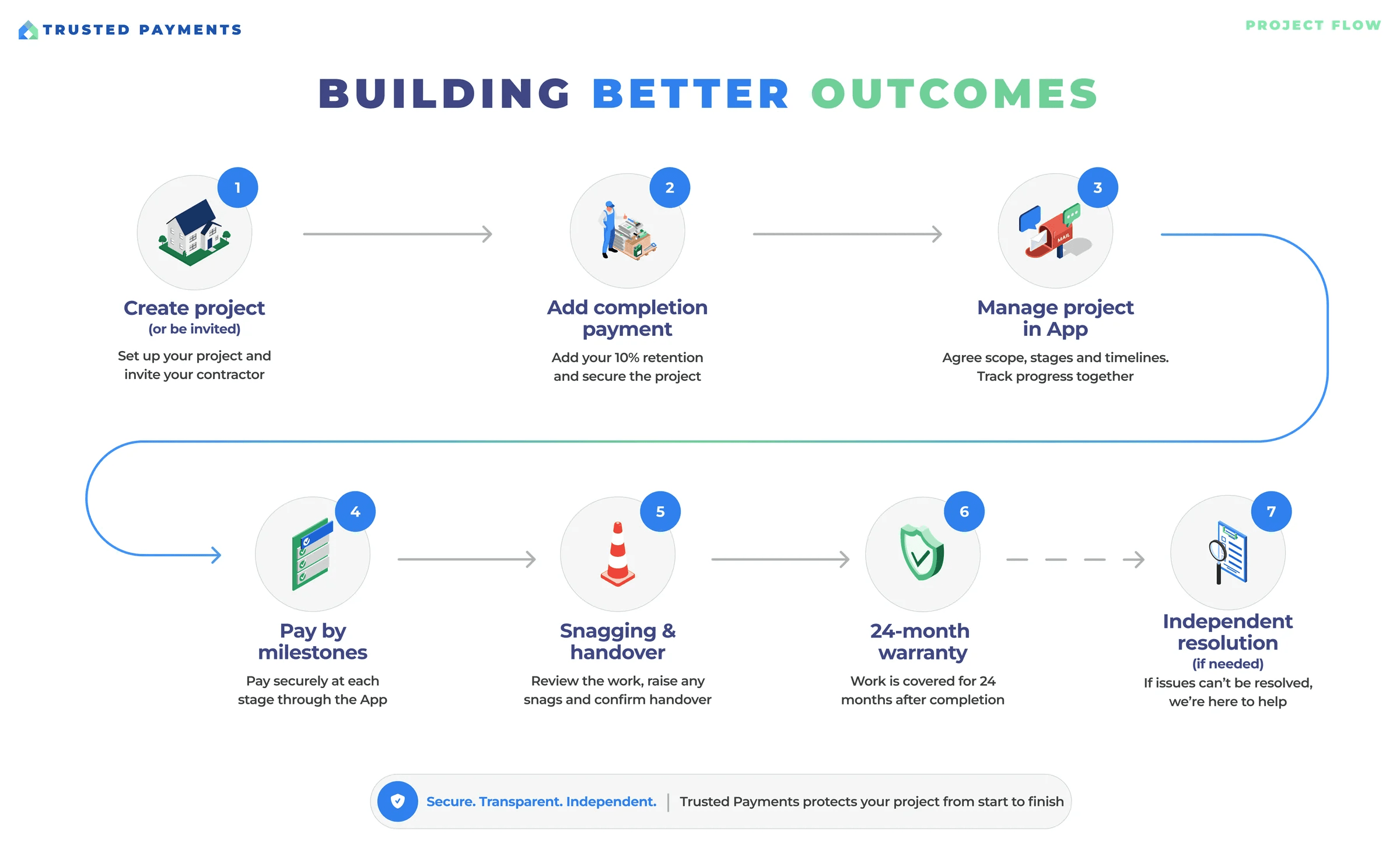
More stages than any other project type, which is to your advantage, each one is a checkpoint. It also means the up-front payment does not need to be large: around 10% is reasonable even on a six-figure build, because the milestones carry the cash flow.
Tie them to structural milestones a surveyor can verify: foundations poured and passed, damp course level, walls to plate height, roof structure complete, watertight, first fix, plastered, second fix.
Never date-based. On a job this long, dates pull you ahead of the work within weeks.
Hold the final 10% until building control has issued the completion certificate, not when the site is tidy.
What usually goes wrong
- Party wall notices served late, stalling the start
- Foundation depth exceeding assumptions with no agreed rate
- Building control inspections missed, requiring work to be opened up
- Scope creep across a long project, unpriced at the time
- Completion certificate never obtained, surfacing at sale
Questions to ask
- Who applies for building control, and are the fees included?
- What foundation depth have you assumed, and what is the rate beyond it?
- Who handles party wall notices?
- At what points will building control inspect, and who arranges it?
- What is your programme, and what would delay it?
- Who is the structural engineer, and who engages them?
How it works
Help your project succeed with Trusted Payments